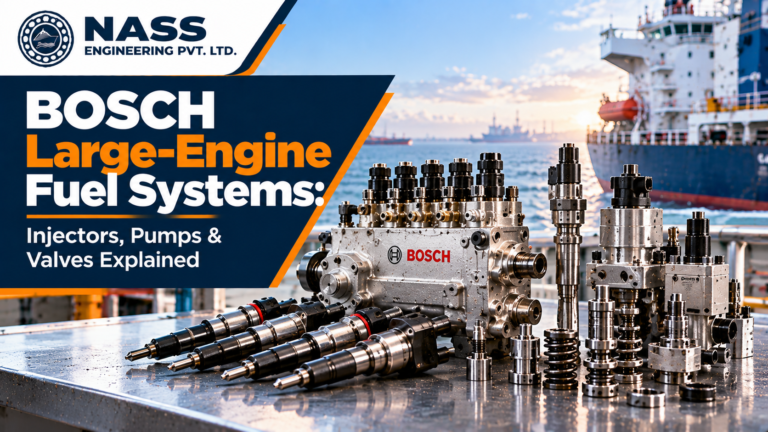
Fuel injection is one of the most important interfaces between a large diesel engine’s fuel system and its combustion process. The injector has to deliver fuel in the quantity, timing and spray pattern required by the engine, while the pump and control system have to maintain the pressure and control required by the specific injection architecture.
For marine and other large-engine applications, the fuel system may use different architectures, including common-rail systems, unit injectors, unit-pump systems and electronically controlled components. Understanding the difference matters when specifying replacement parts, diagnosing poor combustion or planning maintenance.
NASS Engineering Services Pvt. Ltd. states that it is an Authorized Bosch Fuel Injection System Distributor and lists fuel injectors, fuel pumps, complete injection systems and the Bosch LE-GV 400 large-engine gas valve among its product offering.
What Is a Large-Engine Fuel Injection System?
A large-engine fuel injection system controls how fuel is delivered to each cylinder. Depending on the engine architecture, the system can include a low-pressure fuel circuit, high-pressure pump, injector, rail or pressure accumulator, electronic control unit, sensors and associated control components.
The exact configuration varies by engine maker and model. A replacement injector or pump must therefore be matched to the correct engine application and part specification rather than selected only because the component looks similar.
Bosch Fuel Injection Components for Large Engines
NASS Engineering’s Bosch product portfolio includes several categories of fuel-injection components and systems for large-engine applications.
Fuel Injectors
Injectors meter fuel into the engine’s combustion chamber. Their opening characteristics, spray behavior and flow capability are critical to the combustion process.
Bosch’s CRIN-LE common-rail injector is designed for large engines. Bosch states that the product can operate at injection pressures up to 2,200 bar, support up to five injections per cycle and cover cylinder outputs up to 450 kW per cylinder, depending on the application. Bosch also lists qualification for specified drop-in bio- and e-fuels.
High-Pressure Fuel Pumps
The high-pressure pump supplies fuel to the injection system at the pressure required by the engine architecture. Pump condition can therefore influence injection pressure, fuel delivery and overall engine performance.
Bosch describes its CP9 high-pressure pump as a component for large-engine systems and states that the pump can deliver fuel at pressures up to 2,200 bar in the applicable system. Actual operating pressure depends on the engine and system design.
Unit Injectors
In a unit-injector arrangement, the injection pump and nozzle are integrated into a single cylinder-level unit. Bosch states that its unit injector for large engines integrates a high-pressure pump with the injector and can operate at pressures up to 1,800 bar in the applicable system.
Unit-Pump Systems
Unit-pump systems use a separate high-pressure pump module for each cylinder. Bosch describes its unit-pump system as a modular, time-controlled injection system in which each cylinder is supplied by its own pump module and nozzle-holder arrangement. Bosch lists injection pressures up to 1,800 bar for this system.
Complete Injection Systems
NASS Engineering lists complete injection systems as part of its Bosch offering. The product page identifies common-rail systems, unit-injector and unit-pump systems, fuel rails, sensors and control modules as part of the portfolio, depending on application.
For procurement and maintenance, considering the complete system can help when an injector, pump or control component is suspected, because the components operate as an integrated fuel-delivery system.
Understanding Common-Rail Fuel Injection
A common-rail system separates the generation of fuel pressure from the individual injection event. Fuel is maintained in a high-pressure accumulator or rail, while electronically controlled injectors determine when and how much fuel enters the cylinder.
Bosch describes the CRIN-LE as part of a modular common-rail system and notes that the injector includes an integrated pressure accumulator intended to help maintain injection pressure and reduce pressure fluctuations.
The resulting injection strategy is controlled by the engine’s electronic management system and remains specific to the engine manufacturer and calibration.
Why Injector Condition Affects Engine Performance
Fuel-injection components operate under demanding pressure, temperature and contamination conditions. Changes in injector condition can affect spray quality and fuel delivery, which can then influence combustion.
Possible operating symptoms that warrant investigation include:
- Uneven engine operation
- Abnormal exhaust temperature between cylinders
- Increased smoke
- Unexpected changes in fuel consumption
- Difficulty maintaining normal engine performance
- Repeated injector-related faults
These symptoms are not injector-specific diagnoses. Air supply, fuel quality, combustion condition, cooling, turbocharger performance and other engine systems can produce similar indications.
NASS Engineering has previously published a detailed article on why marine fuel injectors fail prematurely, including fuel contamination, component wear and fuel-system maintenance considerations.
Fuel Quality and Injector Life
Fuel quality can influence the operating environment of injection components. Contamination, water and abrasive particles can contribute to wear or poor fuel-system performance when fuel management is inadequate.
For this reason, injector troubleshooting should not stop with removing the injector. Engineers should also consider fuel filtration, purification, storage, fuel quality and the operating history of the system.
NASS Engineering also supplies marine engine spare parts and supports broader diesel-engine maintenance and troubleshooting requirements.
Gas Admission Valves for Large and Dual-Fuel Engines
Large engines operating on gas or dual-fuel systems use different fuel-admission hardware from conventional liquid-fuel injection systems.
Bosch’s LEGV gas admission valve is positioned in the engine inlet duct and meters gaseous fuel into the intake manifold. Bosch states that the LEGV 400 has a geometric cross-section of 400 mm², is designed for up to 500 kW per cylinder in the applicable configuration, and is qualified for gaseous fuels including natural gas, e-biomethane, hydrogen and ammonia. Bosch also lists marine certification for the product.
NASS Engineering’s Bosch product page lists the LE-GV 400 large-engine gas valve as part of its offering for large single-fuel and dual-fuel engine applications.
Single-Fuel and Dual-Fuel Applications
Fuel-system architecture depends on the engine and fuel strategy. In a conventional diesel application, liquid fuel is injected directly into the combustion chamber through the engine’s injection system.
In a dual-fuel engine, the gas system and pilot-fuel injection system work together. Bosch explains that its large-engine gas and dual-fuel portfolio combines gas admission with liquid-fuel injection and electronic engine control.
This means that service and troubleshooting on a dual-fuel engine may require inspection of both the gas-admission side and the liquid-fuel injection side.
Injector Testing and Calibration
Replacing an injector is only part of fuel-system maintenance. Where testing is required, the component should be evaluated against the applicable test and calibration specifications.
NASS Engineering lists Injector Testing & Calibration among its Bosch technical-support services. It also lists fuel-pump repair and reconditioning and diagnostic support using Bosch testing and diagnostic equipment.
For a fleet or workshop, retaining test documentation with the component history provides a useful record for future troubleshooting and procurement.
What to Check When a Fuel Injection System Develops a Fault
A systematic diagnosis is more reliable than changing the first component associated with the symptom.
Start With the Engine Symptom
Record the exact symptom, engine load, speed, cylinder readings, alarms and operating conditions. Determine whether the problem affects one cylinder or the entire engine.
Check the Fuel Supply
Check the low-pressure supply system, filtration and fuel condition according to the engine manufacturer’s procedures.
Check Injection Components
Where the evidence points to an injector, pump or control component, inspect and test the relevant part rather than assuming replacement is required.
Check Air and Combustion Conditions
Fuel injection does not operate independently from the air system. Intake restriction, turbocharger condition, charge-air temperature and exhaust restrictions can affect combustion and produce symptoms similar to fuel-system faults.
Check Electronic Controls
Electronically controlled systems use sensors and control units to manage injection. Fault codes and measured parameters should be interpreted using the engine manufacturer’s diagnostic procedures.
Genuine Components and Application Matching
Fuel-injection parts are precision components. The correct part is determined by the engine, injection system, calibration and application requirements.
NASS Engineering states that its Bosch offering focuses on genuine Bosch components and supports OEMs, workshops, fleet operators and resellers. Its product page also lists application coverage for engines from MTU, Cummins, Weichai, Wärtsilä, Daihatsu, MWM, MaK and INNIO Jenbacher, subject to the specific component and engine application.
For procurement, the safest starting point is the engine model, serial number, existing part number and manufacturer documentation.
Bosch Fuel Injection Support from NASS Engineering
NASS Engineering’s current Bosch offering includes:
- Fuel injectors
- Common-rail high-pressure pumps
- Inline and distributor-type pumps
- Electronic fuel pumps
- Fuel feed pumps and repair kits
- Common-rail systems
- Unit injector systems
- Unit pump systems
- Fuel rails, sensors and control modules
- LE-GV 400 large-engine gas valve
- Injector testing and calibration
- Fuel-pump repair and reconditioning
- Diagnostic support and technical assistance
NASS Engineering also combines fuel-system support with broader marine engineering services. Its portfolio includes marine diesel engine troubleshooting, overhaul, turbocharger service, governor overhaul, vibration analysis, laser alignment, precision machining and spare-parts supply.
Marine Engine and Port Support
NASS Engineering Services Pvt. Ltd. lists its head office and workshop in Navi Mumbai, Maharashtra, India, with additional locations in Visakhapatnam and Kolkata. It also lists overseas entities in Ras Al Khaimah, United Arab Emirates, and Dammam, Saudi Arabia, together with marine engineering port coverage in Saudi Arabia, the UAE and Qatar.
The required service arrangement depends on the vessel’s location, engine model, fuel-system architecture, operating schedule and whether the work is needed onboard, in port or during a planned overhaul.
Final Takeaway
Large-engine fuel injection is a complete system rather than a single component. Injectors, high-pressure pumps, rails, unit-injector or unit-pump arrangements, sensors and electronic control systems all have defined roles that depend on the engine architecture.
For conventional diesel engines, correct injector and pump condition supports the intended fuel-delivery and combustion process. For gas and dual-fuel engines, additional gas-admission hardware such as the Bosch LEGV system becomes part of the fuel-control architecture.
NASS Engineering provides Bosch fuel-injection products and technical support and combines them with marine diesel engine troubleshooting, overhaul, diagnostics and spare-parts capabilities. The correct component and service scope should always be established from the exact engine application and applicable manufacturer requirements.
Meta Information
Meta Title: Bosch Large-Engine Fuel Systems | Injectors, Pumps & Valves
Meta Description: Learn how Bosch large-engine fuel systems work, including injectors, high-pressure pumps, common rail, unit injectors and LEGV gas admission valves.