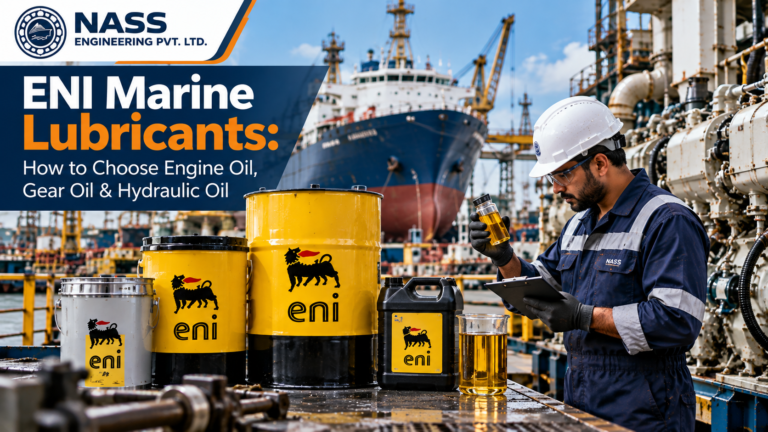
Marine lubricants are not interchangeable simply because two products have the same basic viscosity grade. The correct lubricant depends on the equipment, operating conditions, manufacturer’s requirements, lubricant specification, and the service environment in which the machinery operates.
In marine and offshore operations, lubricants may be required for main and auxiliary engines, gearboxes, transmissions, hydraulic systems, compressors, turbines and other machinery. Selecting the correct product and maintaining lubricant condition are therefore important parts of machinery maintenance.
NASS Engineering Services Pvt. Ltd. states that it is an authorized distributor for ENI Lubricants for the marine and offshore sector. Its product page lists marine engine oils, gear oils, hydraulic oils, transmission oils, greases, synthetic lubricants, compressor oils and turbine oils.
What Are Marine Lubricants?
Marine lubricants are formulated for machinery operating in marine environments and are selected according to the requirements of the equipment in which they are used. Their functions can include reducing friction, controlling wear, helping remove or suspend contaminants, protecting surfaces from corrosion, and supporting reliable operation within the specified temperature and load range.
The exact lubricant requirement is equipment-specific. Engine oil, gearbox oil and hydraulic oil should not be treated as interchangeable products unless the equipment manufacturer specifically permits the application.
Why Correct Lubricant Selection Matters
Using an unsuitable lubricant can create problems ranging from poor lubrication and deposit formation to accelerated wear or incompatibility with seals and other components. The risk is particularly important in machinery that operates continuously or under variable loads.
Before choosing a lubricant, engineers should establish:
- The equipment make and model
- The manufacturer’s required lubricant specification
- Viscosity and temperature requirements
- Operating load and speed
- Fuel and combustion conditions where relevant
- Existing lubricant condition and service history
- Any applicable approval or specification requirements
ENI Lubricant Categories Offered by NASS Engineering
NASS Engineering’s ENI product page lists several lubricant categories for marine, offshore and industrial applications.
Marine Engine Oils
Marine engine oils are designed for lubrication of engine components under the operating conditions specified by the engine manufacturer and lubricant supplier. Selection should take into account the engine type, fuel, oil specification, duty cycle and operating conditions.
Lubricant condition should also be monitored during service. Changes in viscosity, contamination, oxidation or other oil properties can provide information about the condition of the lubrication system and machinery.
Gear Oils
Marine gearboxes depend on the correct lubricant to protect gears, bearings and related components. The required oil specification is determined by the gearbox manufacturer and must be matched to the transmission design and operating conditions.
This is particularly important when gearbox maintenance or overhaul is planned. NASS Engineering also provides marine gearbox repair and overhaul support, so lubricant selection can form part of a broader gearbox maintenance program.
Hydraulic Oils
Hydraulic systems are used throughout marine machinery and can include steering, deck equipment, control systems and other hydraulic applications. The correct hydraulic oil should be selected using the equipment manufacturer’s specified viscosity and performance requirements.
Transmission Oils
Transmission systems have their own lubrication requirements based on gear arrangement, load, speed and operating temperature. Using an engine lubricant in a transmission application, or vice versa, should never be assumed to be acceptable.
Greases
Grease is used where a lubricant needs to remain in contact with a component rather than circulate through an oil system. The correct grease depends on the bearing or component design, load, temperature, water exposure and manufacturer specification.
Synthetic Lubricants
Synthetic lubricants are engineered for specific applications and operating conditions. Their use should be based on compatibility, required specification and manufacturer recommendations rather than simply assuming that synthetic products are suitable for every marine application.
Compressor Oils
Compressors have lubrication requirements that depend on compressor type, operating conditions and the equipment manufacturer’s specification. Correct oil selection and contamination control are important for maintaining compressor reliability.
Turbine Oils
Turbine lubrication systems require oil selected for the specific turbine design and operating conditions. Oil cleanliness, water contamination and degradation should be monitored as part of the machinery maintenance program.
Marine Engine Lubricant Selection: What Engineers Should Check
For a marine diesel engine, lubricant selection should begin with the engine manufacturer’s documented requirements. Important factors can include engine design, operating speed, load, fuel type, oil specification, crankcase arrangement and the expected operating environment.
Engineers should also consider the service history. If an engine has experienced abnormal deposits, increased oil consumption, bearing wear or contamination, lubricant condition should be included in the investigation instead of treating oil replacement as the only corrective action.
Lubricant Condition Monitoring
Changing oil at an arbitrary interval does not provide the complete picture of machinery health. Where an appropriate oil-analysis program is available, laboratory results can help identify trends in contamination, degradation and wear-related particles.
Oil monitoring can be considered alongside vibration, temperature and other condition-monitoring methods. NASS Engineering provides vibration analysis and laser alignment as part of its condition-monitoring services.
How Lubrication Problems Can Affect Marine Diesel Engines
Lubrication problems can contribute to accelerated wear of bearings, liners, pistons, gears and other components. Contamination can also change the lubricant’s ability to protect moving surfaces.
NASS Engineering’s existing article on centrifugal filtration and liner wear discusses how contaminants and lubricant condition can be connected to machinery wear. The appropriate filtration and lubrication strategy should always be selected for the specific engine and system.
Lubricant Storage and Handling
Good lubricant management starts before the oil reaches the machinery. Containers should be stored according to the lubricant supplier’s instructions and protected from contamination, water ingress and unnecessary exposure to temperature extremes.
Where multiple lubricants are stored onboard or at a workshop, clear labeling and dedicated handling equipment can reduce the chance of cross-contamination.
Common Marine Lubrication Mistakes
- Using an oil solely because the viscosity appears similar
- Mixing products without checking compatibility
- Ignoring contamination or water ingress
- Failing to record oil changes and operating hours
- Using an outdated lubricant specification
- Storing oil where water or dirt can enter the container
- Assuming every engine or gearbox can use the same product
These are management and process issues as much as product-selection issues. A consistent lubrication program should connect the lubricant to the exact equipment and its maintenance documentation.
ENI Lubricants for Marine and Offshore Applications
NASS Engineering’s product portfolio identifies ENI Lubricants for marine and offshore requirements and lists a range of lubricant categories for customers in India.
The available product categories listed by NASS include:
- Marine engine oils
- Gear oils
- Hydraulic oils
- Transmission oils
- Greases
- Synthetic lubricants
- Compressor oils
- Turbine oils
The correct product must still be selected against the equipment manufacturer’s requirements. A distributor can help with product availability and technical information, but the equipment specification remains the starting point for selection.
Connecting Lubrication With Marine Engine Maintenance
Lubrication is one part of a larger marine maintenance program. If abnormal oil consumption, repeated bearing failures, contamination, overheating or vibration is occurring, engineers should investigate the underlying machinery condition.
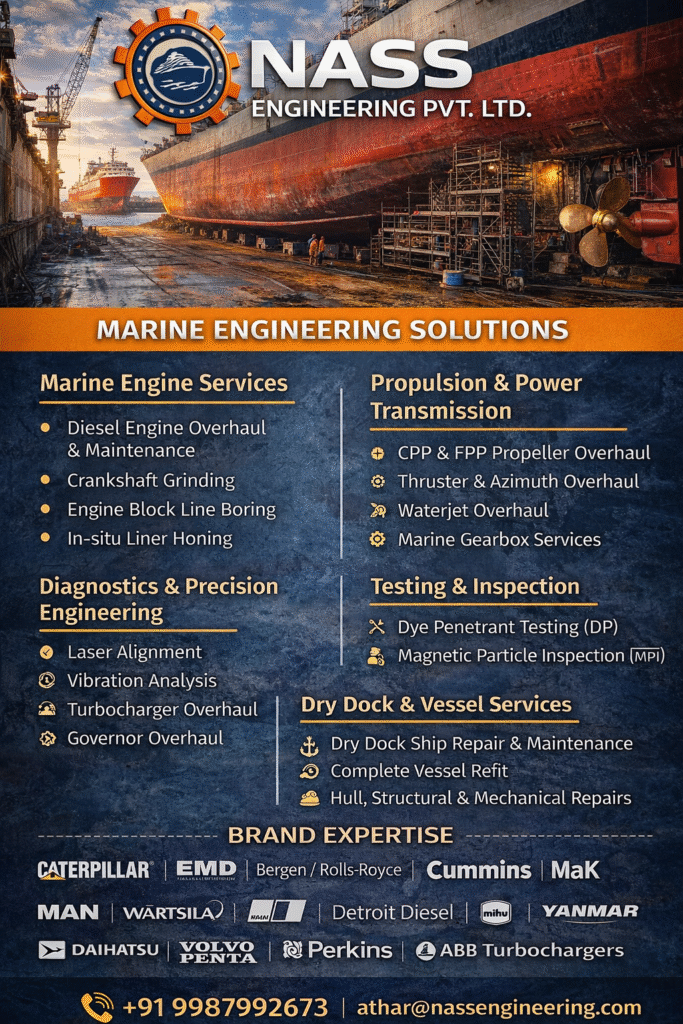
NASS Engineering’s marine diesel engine capability includes troubleshooting, inspection, repair and overhaul across multiple engine makes and models. Its service portfolio also includes turbocharger overhaul, governor overhaul, crankshaft grinding, engine block line boring and in-situ liner honing.
This wider engineering capability is useful when lubricant-related observations point to a mechanical condition that requires investigation.
Marine Lubricant Support From NASS Engineering
NASS Engineering Services Pvt. Ltd. is headquartered in Navi Mumbai, Maharashtra, India, and lists additional offices and workshops in Visakhapatnam and Kolkata. Its global presence includes Ras Al Khaimah, United Arab Emirates, and Dammam, Saudi Arabia. The company’s website also lists marine engineering port coverage for Saudi Arabia, the UAE and Qatar.
For lubricant requirements, the practical product and delivery arrangement depends on the equipment, lubricant specification, vessel location, quantity, delivery requirements and operating schedule.
Final Takeaway
Marine lubricant selection should be specification-led, not based on brand name or viscosity alone. Engine, gearbox, hydraulic, transmission, compressor and turbine applications have different lubrication requirements and need to be matched to the equipment manufacturer’s recommendations.
NASS Engineering provides ENI Lubricants for marine and offshore applications and lists a broad range of lubricant categories through its product portfolio. When lubricant condition is linked to a machinery problem, the investigation should also consider filtration, vibration, alignment and mechanical condition.
For marine operators planning lubricant supply or maintenance support, the right starting point is the equipment identification and required lubricant specification. From there, product selection, supply and condition monitoring can be planned around the vessel’s operating requirements.