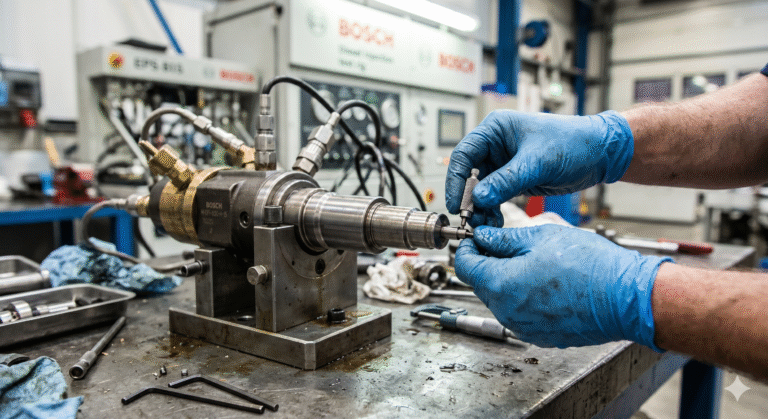
Heavy Fuel Oil (HFO) is essentially liquid asphalt. To make it combust efficiently inside a marine diesel engine, it has to be heated, pressurized to extreme levels, and forced through microscopic holes in the fuel injector nozzle to create a perfectly atomized mist.
When that atomization process breaks down, the results are immediate and catastrophic for your operating budget. Your exhaust temperatures skyrocket, black smoke billows from the stack, and Specific Fuel Oil Consumption (SFOC) spikes. Instead of a fine mist, the injector spits solid droplets of burning fuel directly onto the piston crown, rapidly leading to thermal overload and crown burnout.
When a Chief Engineer sees these symptoms, they know it’s time to pull the injectors. But the bigger question is:
Why did they fail thousands of hours before their expected Time Between Overhaul (TBO)?
In our experience overhauling engines across the Middle East, premature injector failure almost always comes down to one of two things: poor fuel purification, or falling into the “gray market” spare parts trap.
The Anatomy of an Injector Failure
A marine fuel injector is a masterpiece of metallurgical engineering. The clearances between the needle valve and the nozzle body are measured in microns (fractions of a millimeter).
When these components fail early, it is usually due to:
- Erosive Wear: Catalytic fines (cat fines) in poorly purified HFO acting like liquid sandpaper, enlarging the nozzle holes and destroying the spray pattern.
- Corrosive Wear: High sulfur content and water in the fuel creating sulfuric acid that pits the precision-machined surfaces of the needle and seat.
- Thermal Distortion: Continuous operation at overload or improper cooling causing the nozzle tip to warp, preventing the needle from seating and causing the injector to “drip” fuel continuously.
The “OEM-Equivalent” Gray Market Trap
When it’s time to replace degraded nozzles, procurement departments are under massive pressure to cut costs. They often receive quotes for “OEM-equivalent” or aftermarket nozzles that are 40% cheaper than the genuine article.
Do not put these inside your engine.
We recently covered the true cost of this in our breakdown of OEM vs aftermarket marine parts. The aftermarket parts may look identical to the naked eye, but they lack the proprietary metallurgy and microscopic heat-treatment processes of the original manufacturer. Under the brutal 1,500+ bar pressure of a modern common-rail system, those cheap nozzles will erode rapidly, warp, or shatter completely, dropping metal fragments directly into the cylinder.
You saved $2,000 on nozzles, but you just bought yourself a $150,000 marine diesel engine overhaul.
Why We Demand Bosch (And Why You Should Too)
At NASS Engineering, our riding squads do not gamble with our clients’ engine blocks. We realized years ago that the only way to guarantee first-time-fix reliability and exact calibration was to control the supply chain ourselves.
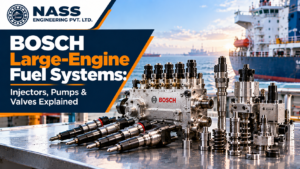
That is why NASS Engineering operates as an Authorized Bosch Fuel Injection System Distributor.
Bosch is the undisputed global benchmark for marine fuel injection technology. By sourcing directly through our authorized channel, fleet managers operating in the Arabian Gulf and Red Sea guarantee three things:
- Zero Counterfeit Risk: You receive 100% genuine, factory-sealed Bosch components, eliminating the risk of catastrophic gray-market failures.
- Exact OEM Calibration: We don’t just supply the parts; our technicians calibrate the opening pressure and spray patterns on certified test rigs to match your engine builder’s exact specifications before they ever reach your vessel.
- Rapid Regional Deployment: Because we maintain an authorized inventory, we bypass the massive lead times of ordering from Europe. Whether your vessel is tied up in Dammam or waiting at anchorage in Fujairah, we deliver genuine parts directly to the ship.
Secure Your Combustion
Do not let compromised fuel injection systems slowly destroy your engine components and drain your fuel budget.
If your fleet is experiencing high exhaust temperatures or is approaching a scheduled overhaul, contact NASS Engineering’s supply division. From genuine Bosch procurement to complete in-situ calibration via our marine engineering services in Saudi Arabia and marine engineering services in UAE ports, we ensure your engine burns fuel exactly the way the manufacturer intended.