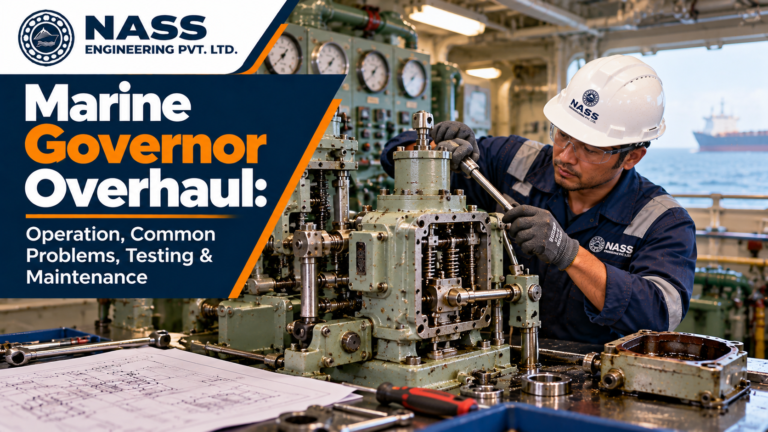
A marine engine governor helps regulate engine speed as engine load changes. Depending on the engine and control architecture, the governor may use mechanical, hydraulic or electro-mechanical means to influence fuel delivery and maintain the required speed.
NASS Engineering Services Pvt. Ltd. states that it carries out complete overhauls for Woodward and Zexel governors. Governor overhaul is part of the company’s wider marine engine service capability, which includes diesel engine troubleshooting, engine overhaul, turbocharger overhaul, fuel-system work, vibration analysis and precision engineering.
This guide explains the role of a marine governor, the symptoms that may indicate a problem, the main stages of a professional governor overhaul, and why governor troubleshooting should always consider the wider engine and fuel system.
What Is a Marine Engine Governor?
A governor is a control device used to regulate engine speed. In a mechanical-hydraulic governor, engine speed is sensed mechanically and the governor acts through a control mechanism to adjust the engine’s governing input as load changes.
Woodward describes its mechanical-hydraulic governors as solutions for diesel, gas and dual-fuel engines and other applications. Its current range includes UG, PG, SG and EGB families, used in applications that include marine and power generation.
The exact construction and service procedure depend on the governor model. Model and serial-number identification should therefore be established before parts are ordered or dismantling begins.
Why Governor Condition Matters
A governor sits between engine-speed behavior and the mechanism controlling engine output. When the governor is not responding correctly, the engine may show unstable speed, sluggish load response or difficulty maintaining the required operating condition.
However, speed fluctuation is not automatically proof of governor failure. Woodward’s PG governor documentation specifically recommends checking load and engine operation and notes that speed variations do not necessarily originate from the governor. Injector and cylinder operation are among the checks that can also be relevant.
Common Signs of a Marine Governor Problem
Engine Hunting
Hunting describes repeated fluctuation around the desired engine speed. A governor issue can contribute, but changing load, fuel-system condition, engine combustion, linkage condition and other control problems should also be investigated.
Sluggish Speed Response
If the engine responds slowly to load changes, the governor mechanism, actuator, linkage, fuel system and engine condition may all need to be examined.
Abnormal Speed or Overspeed Indications
Unexpectedly high engine speed requires immediate attention. The engine manufacturer’s protection and shutdown procedures should always be followed, and the root cause should be investigated before normal operation resumes.
Oil Leakage
Hydraulic and mechanical-hydraulic governors use oil as part of their operating system. Leakage at seals, joints or housings should therefore be investigated.
Contaminated Governor Oil
Woodward identifies contaminants and foreign matter in governor oil as major sources of governor trouble and recommends clean or filtered oil for applicable governor systems.
What Can Cause Governor Problems?
- Contaminated or degraded governor oil
- Wear in moving mechanical components
- Seal deterioration
- Incorrect adjustment
- Linkage wear, binding or excessive play
- Hydraulic problems
- Control-system faults
- Engine or fuel-system faults that appear as speed instability
Several causes can produce the same symptom. Correct troubleshooting therefore matters before a governor is removed for overhaul.
Marine Governor Overhaul: Main Stages
1. Record Governor Identification
Record the make, exact model and serial number before dismantling. Woodward specifically recommends supplying the governor model and serial number when requesting information or parts.
2. Review the Operating History
Review the reported symptom, recent engine work, operating hours, governor adjustments, oil history and previous repairs. This information can help determine whether the issue is sudden, gradual or recurring.
3. Controlled Dismantling
The governor should be dismantled according to the applicable service procedure. Small internal parts need controlled handling because contamination, incorrect assembly or loss of adjustment information can create problems during reassembly.
4. Cleaning
Cleaning removes oil deposits, sludge and contamination so internal components can be inspected accurately. Woodward’s SG overhaul documentation emphasizes the importance of clean tools and a clean work area during governor maintenance.
5. Inspection and Measurement
Components should be inspected for wear, scoring, corrosion, seal condition, damaged threads and abnormal clearances. Where the manufacturer specifies dimensional limits, measurements should be recorded against those limits.
6. Component Renewal
Depending on the model and inspection findings, worn seals, bushings, bearings or other service parts may require replacement. The exact replacement scope should come from the governor’s condition and applicable service specifications.
7. Reassembly
Following inspection and repair, the governor is reassembled using the specified procedures, lubrication and adjustment settings for the model.
8. Calibration and Testing
After mechanical work, the governor must be checked for correct operating response. Testing should verify that the overhauled unit performs within the intended control range.
Woodward’s current repair-and-overhaul service information describes functional flow testing and recalibration to original product specifications for applicable products.
Governor Oil Maintenance
Governor oil condition can directly affect reliability. Woodward’s PG governor manual states that oil contaminants and foreign matter are major sources of governor problems and explains that oil-change intervals depend on service conditions, operating temperature and oil quality.
This means the governor’s exact oil requirement and maintenance interval should be taken from the specific governor documentation rather than applying one universal change interval.
Why Cleanliness Matters During Governor Repair
Mechanical-hydraulic governors contain precision components and passages where contamination can interfere with movement or hydraulic operation.
Woodward’s SG governor overhaul documentation specifically emphasizes clean tools and a clean work area during maintenance and repair.
Workshop cleanliness should therefore be treated as part of the technical repair process.
Governor Troubleshooting: Check the Engine Too
One of the most useful principles in governor troubleshooting is to confirm the complete symptom before removing the governor.
For example, unstable speed may be influenced by:
- Rapid or changing load
- Fuel-injector condition
- Fuel-pump performance
- Linkage wear or binding
- Engine misfiring
- Governor adjustment
- Hydraulic problems
- Electronic control-system faults
Woodward’s PG maintenance documentation explicitly recommends checking load and engine operation when investigating speed variation before concluding that the governor itself is defective.
Mechanical-Hydraulic Governors in Modern Marine Applications
Many modern marine engines use electronic engine-management systems, but mechanical and hydraulic governors remain installed on numerous engines and applications.
Woodward’s current governor portfolio includes mechanical-hydraulic UG and PG families and electronically controlled actuator solutions. The correct equipment depends on the specific engine and control architecture.
For maintenance teams, this makes exact model identification important before choosing overhaul parts or procedures.
Marine Governor Overhaul Checklist
- Record governor make, model and serial number
- Review the engine and governor history
- Document the reported operating symptom
- Check engine load and operating conditions
- Inspect governor oil condition
- Inspect external linkages and connections
- Dismantle according to the applicable service procedure
- Clean internal components
- Measure critical components and clearances
- Replace worn parts as required
- Reassemble using the correct procedure
- Adjust and calibrate the governor
- Complete functional testing
- Record the work performed and test results
When Should a Marine Governor Be Overhauled?
A governor may require overhaul when inspection shows significant wear, when the manufacturer specifies an overhaul requirement, or when persistent symptoms justify deeper inspection.
Woodward notes that governors can wear gradually and may show indications such as slight hunting or sluggish operation before a complete failure.
That makes planned inspection useful when operating behavior changes, especially on engines where an uncontrolled speed problem could have significant consequences.
Governor Overhaul During Marine Engine Maintenance
When a marine diesel engine is undergoing major maintenance, governor condition should be considered alongside fuel injection, turbocharger performance, lubrication, cooling and other engine-control components.
NASS Engineering provides marine diesel engine troubleshooting and complete overhaul services. Its related capabilities include turbocharger overhaul, injector and fuel-pump support, vibration analysis, laser alignment and precision engine work.
This wider approach can help determine whether unstable engine speed is caused by the governor or by another part of the engine system.
Woodward and Zexel Governor Overhaul from NASS Engineering
NASS Engineering states that it carries out complete overhauls for Woodward and Zexel governors.
The governor service is supported by the company’s wider marine engineering capabilities, including diesel engine troubleshooting and overhaul, turbocharger overhaul, crankshaft grinding, engine block line boring, in-situ liner honing, laser alignment, vibration analysis and non-destructive testing.
Marine Engineering Support in India and International Ports
NASS Engineering Services Pvt. Ltd. lists its head office and workshop in Navi Mumbai, Maharashtra, India, with additional locations in Visakhapatnam and Kolkata. Its overseas presence includes Ras Al Khaimah, United Arab Emirates, and Dammam, Saudi Arabia. The company also lists marine engineering port coverage in Saudi Arabia, the UAE and Qatar.
The practical service arrangement for governor work depends on the governor model, engine type, vessel location, operating schedule and whether the unit is serviced onboard, in port or at a workshop.
Conclusion
Marine governor maintenance is a precision-engineering activity. Hunting, sluggish response, oil leakage and contaminated governor oil can be useful warning signs, but they should be investigated in the context of engine load, fuel delivery and overall engine condition.
A professional overhaul can include identification, controlled dismantling, cleaning, inspection, measurement, component renewal, reassembly, adjustment, calibration and functional testing. Correct oil management and clean workshop practices are also important for mechanical-hydraulic governor systems.
NASS Engineering provides complete Woodward and Zexel governor overhaul support as part of its wider marine diesel-engine maintenance and repair capability.
Meta Information
Meta Title: Marine Governor Overhaul | Woodward & Zexel Service Guide
Meta Description: Learn marine governor overhaul steps, common problems, oil maintenance, inspection, calibration and Woodward and Zexel governor support from NASS Engineering.