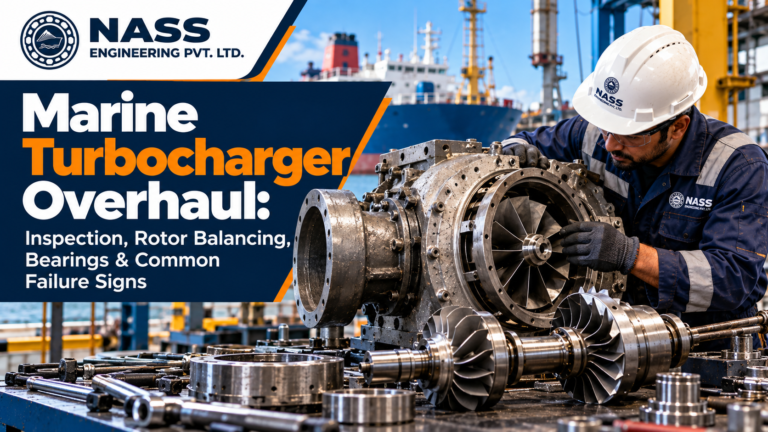
A marine turbocharger is a critical part of the engine’s air and exhaust system. It uses exhaust-gas energy to drive a turbine connected to a compressor, increasing the air supplied to the engine. Because the turbocharger operates at high rotational speed and temperature, its bearings, rotor, seals, turbine, compressor and lubrication system require controlled inspection and maintenance.
NASS Engineering Services Pvt. Ltd. states that it provides turbocharger overhaul and has an experienced team handling rotor balancing and bearing renewal for ABB make turbochargers.
This guide explains the main stages of a marine turbocharger overhaul, common warning signs, the importance of rotor balancing and bearing condition, and how turbocharger work fits into a wider marine diesel engine maintenance program.
What Does a Marine Turbocharger Do?
A turbocharger has two principal flow sides. Exhaust gas drives the turbine, while the turbine shaft drives the compressor on the air side. The compressor supplies pressurized air to the engine, supporting combustion and helping the engine develop its intended power.
The exact bearing arrangement, sealing system, cooling arrangement and operating limits depend on the turbocharger model. Service procedures therefore need to follow the documentation for the installed equipment.
Why Turbocharger Condition Matters
Turbocharger performance affects the amount of air available to a turbocharged diesel engine. A change in turbocharger condition can therefore be accompanied by reduced load response, increased smoke, abnormal exhaust temperatures, unusual noise or vibration.
These symptoms are not proof that the turbocharger is the root cause. Fuel injection, air filtration, charge-air cooling, exhaust restrictions, engine condition and operating load can produce similar symptoms. Troubleshooting should therefore consider the complete engine system.
Common Signs of a Marine Turbocharger Problem
Reduced Engine Performance
A vessel may show slower acceleration or difficulty maintaining expected engine performance at higher load. Engineers should compare current readings with the engine’s normal operating baseline and investigate both fuel and air systems.
High Exhaust Temperature
Abnormal exhaust temperature can have several causes, including combustion problems, fuel-injection issues, inadequate air supply or exhaust-side restrictions. Individual cylinder readings can help determine whether the problem is localized.
Increased Smoke
Changes in exhaust smoke can indicate a change in combustion conditions. Black smoke can be associated with a mismatch between fuel delivery and available air, but the underlying cause needs to be identified through inspection and measurement.
Unusual Noise or Vibration
A new sound or increased vibration from a turbocharger should be investigated. Rotor imbalance, bearing deterioration, deposits, foreign-object damage and other mechanical conditions can contribute to abnormal operation.
NASS Engineering also provides vibration analysis as part of its condition-monitoring services.
Oil Leakage
Oil around the turbocharger should be investigated. The source may involve seals, connections, lubrication conditions or another mechanical issue depending on the turbocharger design.
Marine Turbocharger Overhaul Process
1. Identify the Turbocharger
Before dismantling, confirm the turbocharger manufacturer, model, serial number and service history. Correct identification matters because clearances, parts and inspection procedures vary between models.
2. Controlled Dismantling
The turbocharger is dismantled using the applicable service procedure. Components should be kept identified and protected from contamination so that their condition can be assessed correctly.
3. Cleaning and Initial Inspection
Deposits and oil residue can conceal surface defects. Cleaning allows the overhaul team to inspect turbine and compressor components, housings, bearings, seals and passages for wear, fouling, erosion, scoring, cracks or other indications.
4. Rotor Inspection
The rotor is a critical high-speed assembly. Its condition should be checked for damage, runout, surface condition and other deviations from the manufacturer’s limits.
5. Rotor Balancing
Mass imbalance in a high-speed rotating assembly can increase vibration and loads on bearings. Balancing is therefore an important part of turbocharger overhaul where required by the equipment and service procedure.
NASS Engineering specifically lists rotor balancing within its ABB turbocharger overhaul capability.
6. Bearing Inspection and Renewal
Bearings support the rotating assembly and help maintain the intended operating position of the rotor. Wear, scoring, overheating or abnormal clearances can affect turbocharger performance and reliability.
NASS Engineering also lists bearing renewal as part of its ABB turbocharger overhaul service.
7. Seal and Lubrication Checks
Seals, oil passages, connections and related components should be inspected according to the specific turbocharger design. Lubrication condition is especially important because inadequate or contaminated oil can contribute to bearing and rotating-component problems.
8. Turbine and Compressor Inspection
Turbine and compressor wheels should be checked for fouling, erosion, foreign-object damage and other defects. Repair or replacement should be decided using the applicable manufacturer’s requirements and measured condition.
9. Reassembly and Final Testing
After inspection and repair, the turbocharger is reassembled according to the applicable procedure. Final balancing, inspection and testing should be completed before the unit returns to service.
Why Rotor Balancing Matters in a Marine Turbocharger
A turbocharger rotor operates at high rotational speed. Small differences in mass distribution can become significant when rotational speed rises, which is why balancing is an important part of overhaul work.
Balancing should be performed using the appropriate equipment and acceptance criteria for the specific rotor. Generic tolerances should not be applied without reference to the equipment requirements.
Turbocharger Bearing Wear and Its Effects
When bearing condition deteriorates, the rotor may no longer maintain its intended running position. Depending on the design and severity, this can contribute to vibration, abnormal noise, seal problems, reduced performance or internal contact.
Repeated bearing problems should also trigger a review of lubrication, oil contamination, alignment and operating conditions instead of only replacing the bearing.
Common Causes of Turbocharger Deterioration
- Inadequate or contaminated lubrication
- Excessive deposits or fouling
- Foreign-object damage
- Rotor imbalance
- Bearing wear
- Abnormal temperature conditions
- Air-side or exhaust-side restrictions
- Operating conditions outside the intended application
Several of these conditions can occur together. A proper overhaul should therefore look for the contributing cause as well as the damaged component.
Turbocharger Maintenance During a Marine Engine Overhaul
A major engine overhaul is a suitable time to review turbocharger condition because the turbocharger is directly connected to engine air management. Fuel injection, cylinder condition, cooling, lubrication and exhaust condition can all influence turbocharger performance.
NASS Engineering provides marine diesel engine overhaul together with crankshaft grinding, engine block line boring, governor overhaul, in-situ liner honing, vibration analysis and laser alignment.
Marine Turbocharger Inspection Checklist
- Confirm manufacturer, model and serial number
- Review operating and maintenance history
- Inspect turbine and compressor sides
- Check for deposits and foreign-object damage
- Inspect rotor condition and dimensions
- Check rotor balance where required
- Inspect bearings and clearances
- Inspect seals and lubrication passages
- Inspect housings and connections
- Complete NDT where required by the repair procedure
- Reassemble to the applicable specification
- Complete balancing and testing
- Document measurements, component replacement and test results
Turbocharger Repair or Replacement?
| Condition | Possible Engineering Approach |
|---|---|
| Localized component wear within service limits | Component-level repair or replacement |
| Rotor imbalance | Inspection followed by appropriate balancing |
| Bearing deterioration | Bearing renewal and inspection of related components |
| Major wheel or rotor damage | Engineering assessment for repair or replacement |
| Repeated failures | Root-cause investigation before another repair |
The correct choice depends on the exact turbocharger condition, manufacturer’s requirements, parts availability, operating requirements and expected downtime.
ABB Turbocharger Overhaul Support from NASS Engineering
NASS Engineering states that it has a qualified and experienced team handling ABB turbocharger overhaul, including rotor balancing and bearing renewal.
The service is supported by broader marine-engineering capabilities covering diesel engine troubleshooting and overhaul, governor overhaul, crankshaft grinding, engine block line boring, in-situ liner honing, laser alignment and vibration analysis.
Marine Engineering Support in India and International Ports
NASS Engineering Services Pvt. Ltd. lists its head office and workshop in Navi Mumbai, Maharashtra, India, with additional locations in Visakhapatnam and Kolkata. Its overseas presence includes Ras Al Khaimah, United Arab Emirates, and Dammam, Saudi Arabia. The company also lists marine engineering port coverage in Saudi Arabia, the UAE and Qatar.
The practical service arrangement depends on the turbocharger model, vessel location, maintenance schedule and whether the unit is serviced onboard, in port or through a workshop overhaul.
Conclusion
A marine turbocharger should be treated as an integral part of the engine’s air and exhaust system. Increased smoke, high exhaust temperatures, reduced performance, unusual noise, vibration or oil leakage can indicate a developing problem, but these symptoms can have several causes.
A structured overhaul includes identification, controlled dismantling, cleaning, inspection, dimensional checks, rotor assessment, balancing, bearing inspection, seal and lubrication checks, reassembly and testing. For high-speed rotating equipment, correct balancing and bearing condition are particularly important.
NASS Engineering provides ABB turbocharger overhaul support including rotor balancing and bearing renewal, together with broader marine engine troubleshooting, overhaul and condition-monitoring services.
Meta Information
Meta Title: Marine Turbocharger Overhaul | Inspection, Rotor Balancing & Bearings
Meta Description: Learn marine turbocharger overhaul steps, common failure signs, rotor balancing, bearing inspection, maintenance and ABB turbocharger support from NASS Engineering.