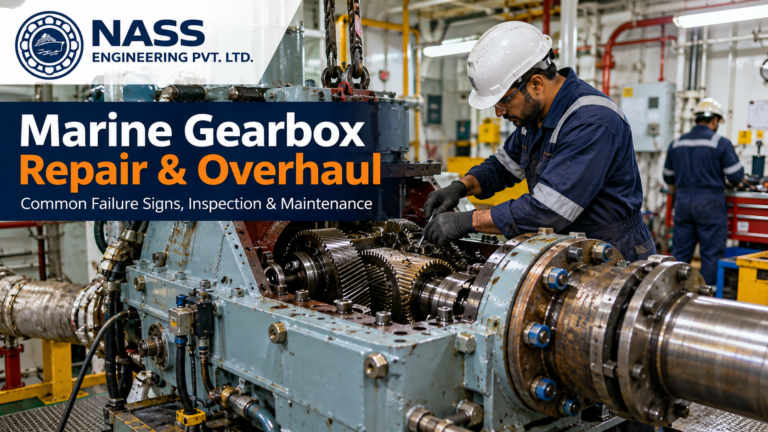
A marine gearbox is a critical part of the propulsion train. It transfers power from the engine to the propeller shaft and must operate reliably through changes in engine load, vessel speed, maneuvering conditions, and sea conditions. When a gearbox develops a problem, the first warning may appear as unusual noise, vibration, temperature rise, oil leakage, clutch engagement problems, or reduced propulsion performance.
For vessel owners, chief engineers, fleet managers, and ship repair teams, early diagnosis is important. A developing gearbox fault can often be investigated and planned for before it becomes an unplanned propulsion failure.
NASS Engineering Services Pvt. Ltd. provides marine gearbox services and states that it has a specialized team for ZF gearboxes along with spare-parts support. Its related marine engineering capabilities include propeller, thruster, waterjet, alignment, vibration analysis, inspection, and dry dock services.
What Does a Marine Gearbox Do?
In a conventional mechanical propulsion arrangement, the marine gearbox sits between the engine and the propeller shaft. Depending on its design, the transmission can reduce engine speed to a suitable propeller speed, transmit the required torque, and provide forward and reverse operation through its gear and clutch arrangement.
A gearbox should therefore be considered as part of the complete propulsion system. Engine condition, shaft alignment, coupling condition, propeller loading, lubrication, and operating profile can all influence gearbox behavior.
Why Marine Gearbox Maintenance Matters
Marine gearboxes contain precision components that work under significant mechanical loads. Gears, bearings, shafts, clutches, seals, and lubrication systems all depend on correct operating conditions.
Regular inspection can help identify developing issues such as:
- Abnormal gear or bearing wear
- Lubricating oil contamination
- Oil leakage around seals or joints
- Unusual operating temperature
- Excessive vibration or noise
- Clutch engagement problems
- Alignment-related loading
The maintenance interval should be determined from the gearbox manufacturer’s documentation, operating hours, vessel duty cycle, and inspection results. There is no single interval that applies to every marine gearbox.
Common Signs of a Marine Gearbox Problem
1. Unusual Gearbox Noise
A change in gearbox noise can indicate a developing mechanical problem. Gear mesh condition, bearing wear, lubrication, coupling condition, and alignment can all influence the noise produced by a transmission.
Engineers should record when the noise occurs, including engine speed, load, forward or reverse operation, and whether the noise changes as the gearbox warms up.
2. Increased Vibration
Vibration does not automatically mean the gearbox is faulty. The source can be anywhere in the propulsion train, including the engine, coupling, shaft line, propeller, or gearbox.
NASS Engineering provides vibration analysis as a condition-monitoring service. Vibration measurements can help engineers identify abnormal frequencies and trends and determine whether further inspection is required.
3. Unusual Temperature Rise
An unexpected rise in gearbox temperature can be associated with lubrication problems, excessive friction, bearing deterioration, abnormal loading, or a cooling-system issue where cooling is part of the installation.
Temperature should be assessed against the manufacturer’s operating limits and the gearbox’s established operating history.
4. Oil Leakage
Oil leakage around a gearbox housing, shaft seal, joint, or connection should be investigated promptly. Loss of lubricant can reduce the protection available to gears and bearings and can also indicate seal deterioration or another mechanical problem.
5. Difficult Forward or Reverse Engagement
Delayed, harsh, or incomplete engagement can result from hydraulic, mechanical, control, clutch, or lubrication-related problems, depending on the gearbox design.
A systematic diagnostic process is important because replacing a clutch component without finding the underlying cause may not resolve a recurring problem.
6. Reduced Propulsion Performance
Poor acceleration, reduced vessel speed, or inconsistent propulsion response can be associated with gearbox problems. However, these symptoms can also result from the engine, propeller, hull condition, control system, or other parts of the propulsion train.
Marine Gearbox Inspection: What Engineers Check
A professional inspection normally begins with the gearbox operating history and external symptoms before moving to detailed component inspection. The final inspection scope depends on the gearbox model, service history, and condition.
Lubricating Oil
Engineers check oil level and condition and may review laboratory oil-analysis results where required. Evidence of contamination or abnormal wear particles can provide useful information about internal component condition.
Gear Teeth
Gear teeth can be inspected for abnormal wear, pitting, scoring, cracking, and unusual contact patterns. Tooth condition can provide clues about lubrication, load distribution, and alignment.
Bearings
Bearings can be assessed for wear, surface condition, clearance, temperature behavior, and lubrication. Bearing deterioration can eventually affect shaft position and gear alignment, making early assessment important.
Clutches and Control Systems
Where a gearbox uses hydraulic or mechanical clutch systems, engineers can assess engagement behavior, pressure, leakage, control components, and related parts in accordance with the gearbox manufacturer’s procedures.
Shafts, Couplings and Seals
Shaft seals should be checked for leakage and wear. Couplings and shaft condition should also be considered when vibration or alignment problems are present.
The Role of Alignment in Gearbox Reliability
A marine gearbox does not operate independently. The engine, gearbox, coupling, shafting, bearings, and propeller form a connected propulsion system. Alignment conditions therefore have a direct effect on how loads are transferred through the system.
Misalignment can increase loads on bearings, couplings, seals, and other components. NASS Engineering provides laser alignment services that can be used when alignment needs to be investigated or verified after machinery work.
Marine Gearbox Repair or Complete Overhaul?
Not every gearbox fault requires a complete rebuild. The appropriate scope depends on inspection findings, component condition, operating history, manufacturer requirements, and the consequences of continued operation.
When Repair May Be Appropriate
- The fault is localized to a specific component
- Remaining components are within applicable service limits
- The gearbox can be restored without broader internal renewal
- The repair is consistent with the manufacturer’s service procedures
When a More Comprehensive Overhaul May Be Required
- Multiple internal components show significant wear
- Inspection reveals progressive or widespread damage
- Repeated failures continue after individual repairs
- The manufacturer’s maintenance requirement calls for a defined overhaul scope
A proper inspection should determine the actual scope rather than treating every failure as a full overhaul.
What Is Included in a Marine Gearbox Overhaul?
The exact procedure varies by gearbox design, but a major overhaul can include several stages:
- Safe isolation and removal where required
- Complete dismantling according to the service procedure
- Cleaning of internal components
- Inspection and measurement of gears, shafts, bearings, and clearances
- Inspection or renewal of seals, gaskets, and other service parts
- Inspection and servicing of clutch and control components
- Replacement of damaged or worn parts
- Reassembly using specified procedures and tolerances
- Lubrication-system checks
- Alignment verification
- Functional testing and commissioning
Documentation of measurements and replacement components is valuable for future maintenance planning and condition tracking.
Why Gearbox Work During Dry Dock Can Be Practical
Dry docking provides access to underwater propulsion components that are difficult to inspect while the vessel is afloat. When gearbox work is being planned alongside shaft, propeller, thruster, rudder, or stern-tube work, coordinating the activities can make the maintenance period more efficient.
NASS Engineering also provides dry dock ship repair support covering structural, mechanical, and propulsion-related work. The correct scope still depends on the vessel, gearbox installation, class requirements, and inspection findings.
How Propeller Condition Can Affect Gearbox Diagnosis
A marine gearbox should not be blamed automatically when propulsion performance changes. Propeller damage, imbalance, cavitation, shaft issues, or other changes in the propulsion train can alter the loads reaching the transmission.
For this reason, gearbox troubleshooting should consider the condition of the wider propulsion system. NASS Engineering also carries out CPP and FPP propeller overhaul work and has published guidance on propeller blade damage and repair.
Marine Gearbox Maintenance Best Practices
Follow the Manufacturer’s Maintenance Requirements
Marine gearboxes differ in design, power rating, clutch arrangement, lubrication system, and application. Manufacturer documentation should be the primary reference for oil specifications, inspection intervals, clearances, service procedures, and overhaul limits.
Monitor Condition Trends
Recording vibration, temperature, oil condition, pressure, and operating observations over time creates a useful baseline. A change from the normal trend can justify a closer inspection.
Investigate Repeated Failures
If the same bearing, seal, clutch, or other component repeatedly fails, investigate the underlying cause. Alignment, lubrication, loading, installation, and connected propulsion components should all be considered.
Plan Spare Parts Before the Maintenance Window
Marine gearbox repair can be delayed when critical components are not available. Reviewing the gearbox identification plate, service history, and required parts before dismantling helps reduce avoidable delays.
Marine Gearbox Services from NASS Engineering
NASS Engineering Services Pvt. Ltd. states that it has a specialized team for ZF gearboxes and stocking spare parts. Its wider marine engineering portfolio includes:
- Marine gearbox inspection and troubleshooting
- Gearbox repair and overhaul support
- Gearbox spare-parts supply
- Laser alignment
- Vibration analysis
- CPP and FPP propeller overhaul
- Bow, tunnel, and azimuth thruster overhaul
- Waterjet overhaul
- Dry dock and vessel refit services
- Dye Penetrant Testing and Magnetic Particle Inspection
The combination of gearbox, propulsion, alignment, inspection, and dry dock capabilities allows a gearbox problem to be considered in the context of the complete propulsion train.
Marine Service Coverage
NASS Engineering Services Pvt. Ltd. is headquartered in Navi Mumbai, Maharashtra, India. The company also lists locations in Visakhapatnam, Andhra Pradesh, and Kolkata, West Bengal, as well as overseas entities in Ras Al Khaimah, United Arab Emirates, and Dammam, Saudi Arabia. The website additionally highlights worldwide marine engineering port coverage for the UAE, Saudi Arabia, and Qatar.
For a vessel requiring gearbox inspection, repair, overhaul, or related propulsion support, service planning can be coordinated according to the vessel’s port, operating schedule, equipment, and technical requirements.
Final Takeaway
Marine gearbox repair should begin with diagnosis rather than assumption. Noise, vibration, temperature rise, oil leakage, clutch problems, and reduced propulsion performance can have several possible causes.
A structured inspection helps determine whether the requirement is a localized repair, component renewal, alignment correction, or a more comprehensive overhaul. Correct lubrication, manufacturer-based maintenance, condition monitoring, and attention to the wider propulsion train all contribute to reliable operation.
For vessels operating in India and international marine environments, NASS Engineering provides ZF gearbox support together with related propulsion, alignment, vibration, inspection, spare-parts, and dry dock services.