Booking a slot at a major shipyard in the Arabian Gulf right now is an operational nightmare. Between the massive backlog in Dubai and the premium emergency rates in Bahrain, forcing a vessel into dry dock for an unscheduled mechanical repair can instantly wipe out a quarter’s profitability.
When a Chief Engineer reports a wiped main bearing or a scored crankshaft, the immediate reaction is usually panic, followed by a call to the shipyard. But engine room technology and in-situ machining have evolved. You do not always need to cut open the hull or pull the vessel out of the water to execute heavy mechanical interventions.
If your vessel is stuck at anchorage or taking on cargo, here are five heavy repairs our riding squads regularly execute afloat—saving fleets millions in off-hire penalties and dry dock fees.
1. Severely Scored Crankshafts
The old rule was simple: if a main bearing wipes and scores the crankshaft journal, the engine block has to be dismantled, the hull breached, and the shaft sent to a land-based machine shop.
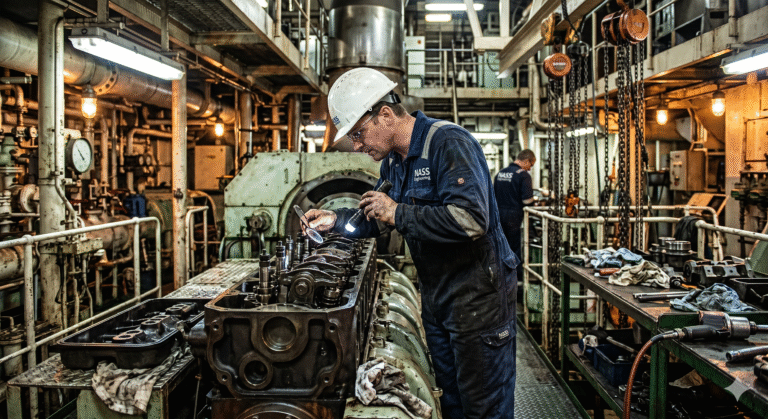
That is no longer true. We routinely deploy specialized, pneumatically driven orbital grinding tools directly onto the engine block while the ship is anchored. By executing in-situ crankshaft machining, we can grind the damaged crankpin or main journal back to exact OEM tolerances, polish it, and fit undersized bearings—all without the shaft ever leaving the engine room.
2. Piston and Cylinder Liner Reconditioning
When lube oil consumption spikes and scavenge port inspections reveal mirror-glazed liners, you are losing compression. Many superintendents assume that pulling liners requires the heavy overhead cranes of a shipyard.
Instead of ripping out the cast iron, we bring the machine shop to you. Using specialized honing rigs, we restore the critical crosshatch pattern directly inside the block. If you are seeing high blow-by or a drop in peak firing pressure, check out our recent breakdown on the 3 signs your engine needs in-situ cylinder liner honing before you start ordering expensive replacement parts.
3. Propeller Blade Damage and Imbalance
Hitting submerged debris in congested shipping lanes is inevitable. When a vessel starts vibrating heavily, the immediate fear is that the tail shaft is compromised, which historically meant an immediate dry dock.
Before you pull the ship out of the water, you need hard data. A specialized riding squad can perform advanced marine vibration analysis directly on the intermediate and tail shaft bearings while the vessel is still in the water. We can definitively tell you if the vibration is coming from an internal bearing failure, or if you simply have ship propeller repair needs, such as a bent blade, that can be cropped and balanced by a commercial dive team afloat. Don’t dry dock the ship for a bent blade.
4. Azimuth Thruster Seal Leaks (OSVs)
For Offshore Supply Vessels (OSVs) operating under strict Aramco charters, a leaking thruster seal is a fast track to failing an OVID inspection and being put off-hire.
While a complete thruster overhaul often requires a dry dock, top-end maintenance, steering gear repairs, and certain hydraulic seal replacements can be managed from the inside while the vessel is tied up at the berth. If you are managing an offshore fleet, utilizing localized marine engineering services in Saudi Arabia ensures that your thrusters are brought back to compliance standards rapidly without waiting for a slot in Dammam.
5. Catastrophic Main Bearing Failures
If you catch a bearing failure before the crankshaft scores, replacing the main bearing shells on a massive two-stroke engine is entirely possible afloat.
It requires precision hydraulic jacking of the crankshaft, absolute cleanliness, and a team that understands how to interpret crank web deflection readings to ensure the shaft hasn’t bowed. We execute these high-stakes interventions via our rapid-response marine engineering services in UAE ports, boarding vessels at Fujairah anchorage or Jebel Ali to swap bearings and get the main engine turning again before the charterer cancels the contract.
Stop Waiting on the Shipyard
Bottom line: waiting for a dry dock slot is burning your charter rate. Every hour your vessel spends dead in the water is revenue you will never get back.
Before you commit to a massive shipyard refit, bring a specialized riding squad onboard to assess the damage. More often than not, the repair you think requires a dry dock can be solved with precision in-situ engineering.