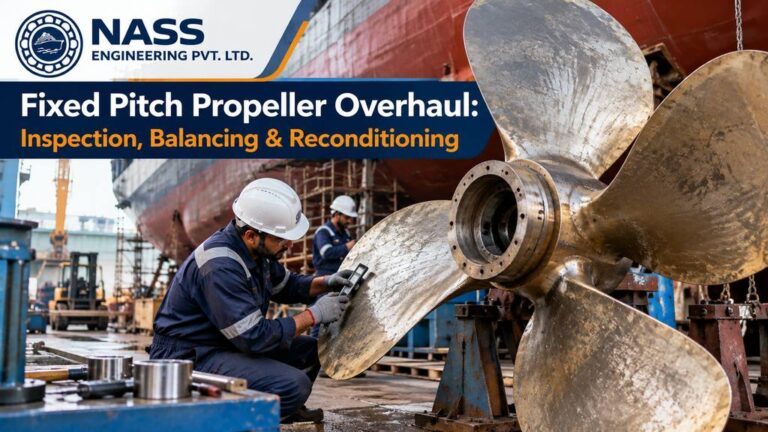
A fixed pitch propeller (FPP) is a mechanically simple but highly loaded component of a vessel’s propulsion system. Its blades are fixed to the hub, so the propeller operates at a predetermined pitch rather than changing blade angle during operation. This makes the condition of the blade geometry, hub, shaft connection, and surrounding propulsion components important to reliable performance.
Wärtsilä defines a fixed pitch propeller as a monoblock propeller optimized for an operating condition, while its marine encyclopedia describes an FP propeller as one whose blades are rigidly attached to the hub. The International Maritime Organization has also documented the role of well-designed fixed-pitch propellers in marine propulsion and notes that propeller maintenance can include polishing and replacement of the propeller.
For vessel owners, fleet managers and chief engineers, FPP propeller overhaul is therefore not simply a blade-cleaning exercise. It is an engineering process that starts with condition assessment and can extend to blade reconditioning, balancing, shaft and stern-tube inspection, sealing work, non-destructive testing, alignment checks and final verification.
What Is a Fixed Pitch Propeller?
A fixed pitch propeller has blades set at a fixed angle relative to the hub. Unlike a controllable pitch propeller, the blade pitch cannot be changed during operation. Changes in thrust are therefore achieved through the propulsion system’s speed and transmission arrangement rather than by continuously changing blade pitch.
FPP systems are widely used on ocean-going vessels and are also found on many commercial, workboat, coastal and special-vessel applications. The suitability of an FPP depends on the vessel’s hull, engine, operating profile and propulsion design rather than on the propeller type alone.
Why FPP Propeller Condition Matters
The propeller converts shaft power into thrust through its interaction with the surrounding water. The blade shape, pitch distribution, surface condition and balance all influence how smoothly that process takes place.
A propeller with damaged or deformed blades can create uneven hydrodynamic loading. The resulting vibration may then be felt through the shaft line, bearings, stern tube or gearbox. Propeller condition should therefore be assessed alongside the wider propulsion system rather than treated as an isolated mechanical issue.
NASS Engineering’s existing guidance on propeller blade damage and repair and ship propeller vibration covers these diagnostic considerations in greater detail.
When Does an FPP Propeller Need an Overhaul?
The need for overhaul should be established from inspection findings, operating history and applicable manufacturer or class requirements. Common reasons for bringing an FPP into a repair or overhaul program include:
- Visible blade damage or deformation
- Cavitation erosion or surface deterioration
- Corrosion or surface pitting
- Persistent propulsion vibration
- Evidence of propeller imbalance
- Shaft, seal or stern-tube concerns
- Damage following contact with underwater debris
- Planned dry dock maintenance requiring underwater inspection
A visible defect does not automatically mean that a propeller must be replaced. The repair decision depends on the extent of damage, the ability to restore the required geometry and condition, and the applicable technical limits.
FPP Propeller Overhaul: Step-by-Step Engineering Process
1. Initial Condition Assessment
The overhaul begins with a review of the propeller’s service history, previous inspection reports and reported operating symptoms. Engineers then examine the propeller, hub, shaft connection and accessible surrounding components.
Particular attention is given to blade edges, pressure and suction surfaces, blade roots, hub areas and any location where cracks, erosion, impact damage or unusual wear may be present.
2. Visual Inspection and Damage Mapping
A detailed visual inspection helps establish the extent and distribution of damage. Findings should be documented so that repair work can be compared with the original condition.
Typical findings may include:
- Leading-edge damage
- Trailing-edge damage
- Tip damage
- Surface pitting
- Cavitation erosion
- Cracks
- Blade deformation
- Corrosion
NASS Engineering’s service offering specifically includes inspection and reconditioning of propeller blades as part of its CP and FP propeller overhaul capability.
3. Non-Destructive Testing Where Required
Where a crack or other discontinuity is suspected, non-destructive testing can help determine whether a component requires further repair.
NASS Engineering provides Dye Penetrant Testing (DP) and Magnetic Particle Inspection (MPI) for components including propeller shafts and blades. The selection of the test method depends on the material, defect type and inspection requirement.
4. Blade Geometry and Pitch Checks
Propeller geometry must be assessed carefully because a blade can look acceptable while still having an altered profile or pitch. Propeller pitch is the theoretical distance a propeller would advance in one revolution without slip. A representative nominal pitch is often defined at a specified blade radius.
During overhaul, engineers may check blade pitch, geometry, profile and relevant dimensions against the applicable design or manufacturer information.
5. Blade Reconditioning and Repair
The repair method depends on the actual damage. Reconditioning can include controlled removal of damaged material, restoration of the blade surface, correction of localized damage and other approved repair procedures.
Where structural repair is required, the procedure must be controlled carefully. Material condition, welding procedure, heat input, dimensional restoration and inspection requirements should be established from the applicable repair specification and manufacturer or classification requirements.
6. Propeller Balancing
Balancing is important because uneven mass distribution can contribute to vibration during rotation. The appropriate balancing method and acceptance criteria depend on the propeller, its application and the governing technical requirements.
Where an imbalance is suspected, balancing should be considered together with blade geometry and the condition of the shaft line. A propeller that has been balanced but remains geometrically inconsistent may still produce uneven loading.
Shaft, Stern Tube and Seal Checks
FPP propeller overhaul should not stop at the blades. The propeller is directly connected to the shaft line, so shaft and stern-gear condition can influence propulsion performance.
Shaft Condition
Engineers can inspect accessible shaft surfaces and relevant connection areas for wear, corrosion, damage, runout or other indications that require further investigation.
Stern Tube Condition
The stern tube contains the bearing and sealing arrangement supporting the propeller shaft as it passes through the hull. The exact inspection scope depends on the vessel’s propulsion arrangement and stern-tube design.
Seal Renewal
NASS Engineering states that its CP and FP propeller overhaul work includes seal renewal and stern tube reconditioning.
Seal condition is important because leakage can lead to lubricant loss or water ingress depending on the sealing arrangement. Seal work should therefore be carried out according to the installed system’s design and service requirements.
FPP Propeller and Shaft Alignment
Propeller work should be considered alongside the alignment condition of the propulsion train. The engine, gearbox, coupling, shafting and propeller operate as an interconnected system.
When alignment is being investigated after machinery work or when there are unexplained vibration or bearing-loading concerns, NASS Engineering provides laser alignment services.
Alignment checks should be interpreted using the equipment manufacturer’s requirements and the specific propulsion arrangement. A generic alignment tolerance should not be applied to every vessel.
What Causes FPP Propeller Damage?
Underwater Impact
Contact with floating or submerged debris can damage leading edges, tips or other blade areas. Even when the damage appears local, engineers should assess whether the blade geometry and balance have changed.
Cavitation
Cavitation can cause localized erosion and surface damage when vapor bubbles form and collapse around the propeller under suitable pressure conditions. Propeller design, loading, wake characteristics and operating conditions all influence cavitation behavior.
Corrosion and Surface Deterioration
Marine propellers operate in a seawater environment. Over time, corrosion, erosion and surface deterioration can affect the condition of the propeller.
Incorrect Repair or Deformation
A blade that has been improperly repaired or deformed can alter thrust distribution. This is why dimensional checks and controlled reconditioning matter during overhaul.
FPP Propeller Overhaul During Dry Dock
Dry docking provides direct access to the underwater hull, propeller and rudder. It therefore creates an opportunity to combine propeller inspection with related propulsion and hull maintenance.
NASS Engineering’s dry dock services include dry dock ship maintenance, shaft, rudder and propeller maintenance, underwater hull repairs, steel renewal, blasting, painting and anti-fouling, together with class survey and third-party inspection support.
Combining related activities can also make the inspection process more efficient because the propeller, shaft line and underwater hull can be assessed within the same planned maintenance window.
FPP Propeller Overhaul Checklist
For a planned overhaul, the following checklist can help define the scope:
- Review previous propeller inspection reports
- Record vessel and propulsion particulars
- Inspect blades, roots, tips and hub
- Map visible damage
- Perform NDT where required
- Measure relevant blade geometry and pitch
- Assess shaft and stern-tube condition
- Inspect sealing arrangements
- Recondition or repair damaged blades as permitted by the repair specification
- Balance the propeller when required
- Verify shaft and propulsion alignment where relevant
- Complete final inspection and documentation
How to Decide Between Repair and Replacement
Repair versus replacement should be treated as an engineering decision rather than a purely commercial one.
| Condition | Potential Engineering Approach |
|---|---|
| Localized surface damage | Inspection followed by suitable reconditioning where permitted |
| Blade deformation | Dimensional assessment and controlled restoration where technically acceptable |
| Crack or suspected discontinuity | NDT and engineering assessment before repair |
| Severe structural damage | Detailed engineering assessment to determine whether repair or replacement is appropriate |
The final decision should be based on the propeller’s actual condition, applicable repair procedures, manufacturer information and any class requirements that apply to the vessel.
Schottel and Berg Propulsion FPP Support from NASS Engineering
NASS Engineering’s services page states that the company has a dedicated team with special tools for Schottel and Berg Propulsion controllable pitch and fixed pitch propeller work. The listed work includes seal renewal, stern tube reconditioning and propeller blade reconditioning.
This service capability complements NASS Engineering’s broader propulsion support, which includes thruster overhaul, waterjet overhaul, marine gearbox service, laser alignment, vibration analysis and non-destructive testing.
For broader technical context, NASS Engineering has also published CPP vs FPP Propulsion Systems, which explains the basic operating differences between the two propeller arrangements.
Marine Engineering Support Across India and International Ports
NASS Engineering Services Pvt. Ltd. lists its head office and workshop in Navi Mumbai, Maharashtra, along with a Visakhapatnam branch and a Kolkata branch and workshop. Its overseas presence includes Ras Al Khaimah, United Arab Emirates, and Dammam, Saudi Arabia. The company also lists marine engineering port coverage for Saudi Arabia, the UAE and Qatar.
This geographic coverage is relevant for vessel operators planning propulsion work because the practical service requirement depends on vessel location, port schedule, equipment condition and whether attendance is required onboard, in port or during dry docking.
Final Takeaway
Fixed pitch propeller overhaul is a condition-driven engineering activity. The objective is not simply to make a propeller look clean after repair. Engineers need to establish the condition of the blades, geometry, balance, hub, shaft connection, sealing arrangement and related propulsion components before determining the appropriate repair scope.
For vessels operating with FPP propulsion, regular inspection and timely reconditioning can help prevent small defects from becoming larger propulsion problems. When propeller issues are accompanied by vibration, seal leakage or alignment concerns, the investigation should extend beyond the propeller itself.
NASS Engineering supports CP and FP propeller overhaul for Schottel and Berg Propulsion systems, including seal renewal, stern tube reconditioning and propeller blade reconditioning. Its related propulsion and condition-monitoring services allow propeller work to be considered as part of the wider vessel maintenance program.