
Crankcase Sludge & Liner Wear: Why Centrifugal Filtration Is Your Engine’s Last Line of Defense
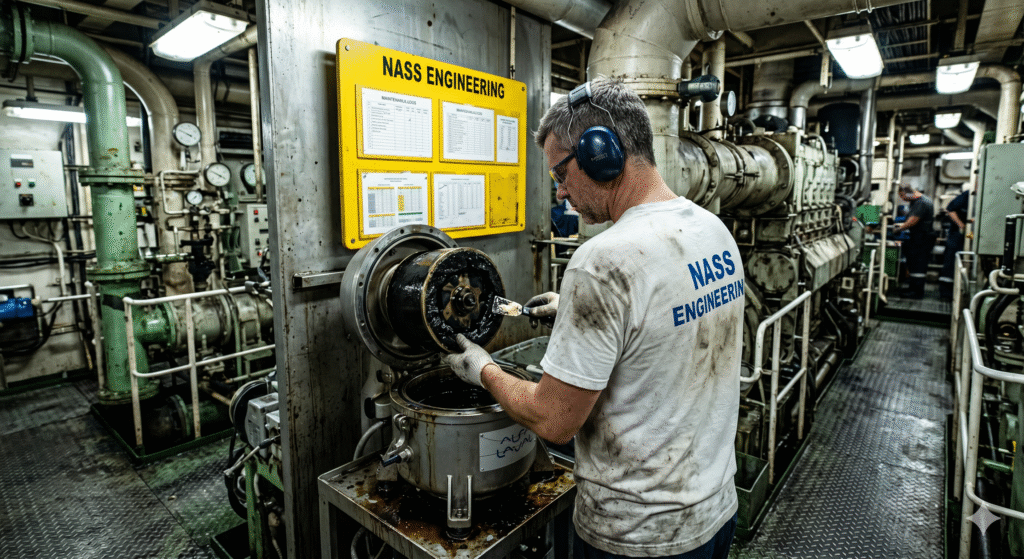
Every Chief Engineer has experienced this exact nightmare: you pull a piston during a routine marine diesel engine overhaul, wipe down the cylinder liner, and realize the crosshatch pattern is completely gone. The liner is mirror-glazed, the piston rings are heavily worn, and the crankcase is coated in a thick, abrasive layer of black sludge. You check the maintenance logs. The automated back-flushing filters have been working perfectly. The lube oil separators are running 24/7. So how is your engine block actively eating itself from the inside out? The answer lies in the microscopic contaminants that standard filtration systems simply cannot catch: sub-micron carbon soot and catalytic fines (cat fines) from burning heavy fuel oil (HFO). If you are cleaning choked auto-filters every few days and constantly battling blow-by, your lube oil is severely contaminated, and your engine’s hydrodynamic boundary layer is failing. Here is the mechanical reality of lube oil contamination, and why aggressive centrifugal filtration is the only way to stop abrasive wear. The Physics of Contamination: Why Standard Filters Fail A standard full-flow paper or wire-mesh filter is designed to catch larger particles—typically anything above 10 to 30 microns. The problem is that the most destructive elements in a marine diesel engine are far smaller than that. When HFO combusts, it generates sub-micron carbon soot. Simultaneously, poor fuel purification allows microscopic cat fines (aluminum and silicon oxides used in the fuel refining process) to slip past the fuel injectors and wash down the cylinder walls into the crankcase sump. Because these particles are smaller than 5 microns, they pass straight through your primary filters. They circulate continuously, building up concentration. Cat fines are almost as hard as diamonds. When they get wedged between the piston ring and the cylinder wall, or embedded into the soft white metal of your main bearings, they act like liquid sandpaper. Ripping the Sludge Out: The Power of Centrifugal Filtration You cannot filter out sub-micron soot with a mesh screen without instantly blinding the filter element. You have to use physics. By installing a bypass centrifugal filter, you harness oil pressure to spin a internal rotor at speeds exceeding 6,000 RPM. This generates centrifugal forces up to 2,000 times greater than gravity. Instead of trying to “catch” the dirt, the centrifuge violently throws the heaviest particles—the cat fines, the heavy carbon soot, and the oxidized oil sludge—out of the oil suspension and slams them against the inner wall of the rotor. The clean oil drains back to the sump, while the lethal abrasive contaminants form a dense, rubbery “sludge cake” inside the rotor that your engineers simply scrape out during routine maintenance. Why We Mandate MANN Hummel Centrifugal Filters When our riding squads board a vessel for emergency marine engineering services in Qatar or the UAE to fix wiped main bearings, the first thing we check is the state of the lube oil purification system. More often than not, the auxiliary centrifuges are either bypassed, broken, or utilizing cheap aftermarket rotors that vibrate violently and fail to achieve proper RPM. At NASS Engineering, we do not compromise on fluid management. We supply and integrate MANN Hummel Centrifugal filters because they are the undisputed benchmark for bypass oil purification. When you source MANN Hummel units and genuine centrifuge spares directly through our authorized supply chain, you guarantee: Stop Wiping Bearings If your lube oil looks like liquid tar within a week of a fresh charge, your primary filters are losing the battle. Do not wait for a low-oil-pressure alarm or a crankcase explosion to upgrade your purification system. To secure your engine’s internal components and source verified MANN Hummel centrifuge assemblies, explore NASS Engineering’s complete spare parts and product list or contact our technical supply division today to get certified parts delivered directly to your next port of call.
The Ultimate Guide to Marine Engine Spare Parts in India: Suppliers, ISO Standards & Rebuilt Engines
Managing the operational budget of a vessel operating along the Indian coastline—whether it is a deep-sea commercial container ship working out of Jawaharlal Nehru Port (JNPT) or a commercial fishing trawler navigating the rough waters of the Arabian Sea—comes down to a single factor: minimizing unplanned downtime. When a critical system like a fuel pump scores or a centrifugal filter clogs, procurement managers face a flood of choices in the Indian maritime market. The pressure to keep operating costs low often leads to a dangerous compromise between cheap gray-market components and verified, certified spares. This comprehensive technical guide answers the most pressing search queries regarding parts procurement, strict quality standards, and the choice between repairing an existing setup versus investing in reconditioned machinery. Where Can I Buy Reliable Marine Engine Spare Parts in India? For fleet managers asking where can I buy reliable marine engine spare parts in India, the answer requires looking beyond generic industrial scrap yards. True reliability means sourcing components that carry a transparent mechanical history, verified metallurgy, and clear dimensional tolerances that match original engine builder blueprints. Operating from our strategic engineering hub in Navi Mumbai, NASS Engineering stands as one of the best marine engine spare parts suppliers near me in India. We eliminate the supply-chain guesswork by maintaining an active, technically vetted inventory designed specifically to withstand high-salinity and high-ambient-temperature environments. Top-Rated Marine Engine Spare Parts Dealers for Commercial Vessels in India Heavy commercial shipping demands dedicated components engineered for long continuous running hours. As one of the top-rated marine engine spare parts dealers for commercial vessels in India, our supply division focuses strictly on high-end machinery lines. Through our specialized logistics network, we supply genuine KVGB Rolls Royce Bergen Marine Engine Spare Parts directly to major Indian ports. Sourcing these heavy medium-speed engine components through verified channels ensures that critical tolerances—such as valve guide clearances and piston ring tension—prevent catastrophic structural failures mid-transit. Recommendations for Marine Engine Spare Parts That Meet ISO Standards in India Operating a commercial vessel legally requires total compliance with international maritime laws and classification societies (such as IRS, DNV, and Lloyd’s Register). If your parts do not carry verified certification, your vessel risks failing port state inspections or voiding insurance coverage. When evaluating recommendations for marine engine spare parts that meet ISO standards in India, technical superintendents must scrutinize the filtration and lubrication systems first. These are the primary defense lines protecting your internal engine block from abrasive wear. To maintain strict compliance, your fluid management systems must utilize certified assets: Which Marine Engine Spare Parts Brand Offers the Best Warranty in India? Procurement teams frequently ask which marine engine spare parts brand offers the best warranty in India. The reality of marine procurement is that a factory warranty is only as good as the supply channel it passes through. If you buy a premium component from an unauthorized “gray market” middleman, the manufacturer will reject any subsequent claim if the part fails prematurely inside your cylinder block. The safest way to secure an ironclad warranty is by sourcing through a direct, factory-authorized partner. NASS Engineering serves as an Authorized Bosch Fuel Injection System Distributor. Sourcing your high-pressure common-rail parts, fuel pumps, and nozzles directly through our authorized channel guarantees that your equipment carries a full, uncompromised factory warranty. Furthermore, every component undergoes exact calibration on certified testing rigs before deployment, completely eliminating the risk of premature erosive wear or needle seizure. Marine Engine Spare Parts vs. Rebuilt Engines: Which is Better for Fishing Boats? For coastal operators debating marine engine spare parts vs rebuilt engines: which is better for fishing boats, the choice hinges on total lifecycle cost analysis. If an older engine block has suffered repeated thermal overloads, has structural micro-cracks, or requires extensive line boring, repeatedly buying piecemeal components becomes a financial drain. You end up paying for continuous labor and freight fees while your boat remains stuck at the jetty, missing prime fishing seasons. In these high-wear scenarios, replacing the entire compromised block with a fully reconditioned unit is the superior financial strategy. It provides a zero-hour mechanical baseline for a fraction of the cost of a brand-new engine from the factory. Affordable Marine Engine Spare Parts for Small Fishing Boats in India We understand that independent operators require rugged, dependable propulsion without corporate overhead costs. If you are looking for affordable marine engine spare parts for small fishing boats in India, balancing cost with long-term survival of the vessel is vital. Instead of running a failing engine to the point of catastrophic seizure, operators can leverage our inventory of certified New and Reconditioned Engines. For larger commercial fishing trawlers and multi-day vessels requiring an absolute powerhouse of reliability, we supply thoroughly overhauled, workshop-tested units like the Caterpillar 3412 Marine Engine. These reconditioned workhorses deliver maximum torque and fuel efficiency, ensuring your boat stays at sea generating revenue rather than burning money on continuous breakdown repairs. Secure Your Fleet’s Supply Chain Do not let sub-standard components compromise your mechanical safety or your operational margins. Whether you need to source a precise replacement nozzle or drop in a completely overhauled engine block, your procurement choices dictate your domain’s uptime. Explore our complete verified inventory via our dedicated spare parts and product list, or contact NASS Engineering’s technical procurement team today to secure ISO-compliant assets for your next scheduled maintenance window.
Why Marine Fuel Injectors Fail Prematurely (And the “Gray Market” Trap)
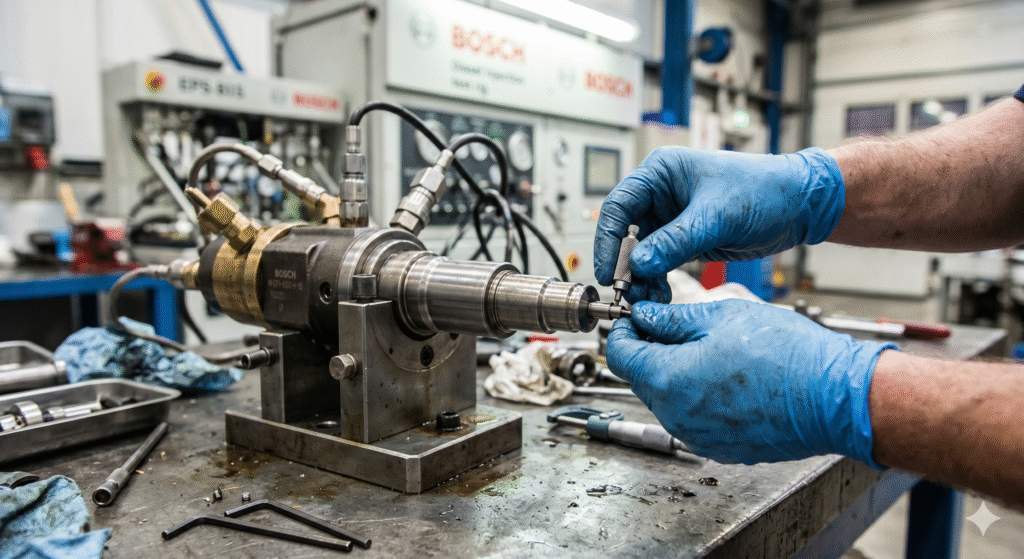
Heavy Fuel Oil (HFO) is essentially liquid asphalt. To make it combust efficiently inside a marine diesel engine, it has to be heated, pressurized to extreme levels, and forced through microscopic holes in the fuel injector nozzle to create a perfectly atomized mist. When that atomization process breaks down, the results are immediate and catastrophic for your operating budget. Your exhaust temperatures skyrocket, black smoke billows from the stack, and Specific Fuel Oil Consumption (SFOC) spikes. Instead of a fine mist, the injector spits solid droplets of burning fuel directly onto the piston crown, rapidly leading to thermal overload and crown burnout. When a Chief Engineer sees these symptoms, they know it’s time to pull the injectors. But the bigger question is: Why did they fail thousands of hours before their expected Time Between Overhaul (TBO)? In our experience overhauling engines across the Middle East, premature injector failure almost always comes down to one of two things: poor fuel purification, or falling into the “gray market” spare parts trap. The Anatomy of an Injector Failure A marine fuel injector is a masterpiece of metallurgical engineering. The clearances between the needle valve and the nozzle body are measured in microns (fractions of a millimeter). When these components fail early, it is usually due to: The “OEM-Equivalent” Gray Market Trap When it’s time to replace degraded nozzles, procurement departments are under massive pressure to cut costs. They often receive quotes for “OEM-equivalent” or aftermarket nozzles that are 40% cheaper than the genuine article. Do not put these inside your engine. We recently covered the true cost of this in our breakdown of OEM vs aftermarket marine parts. The aftermarket parts may look identical to the naked eye, but they lack the proprietary metallurgy and microscopic heat-treatment processes of the original manufacturer. Under the brutal 1,500+ bar pressure of a modern common-rail system, those cheap nozzles will erode rapidly, warp, or shatter completely, dropping metal fragments directly into the cylinder. You saved $2,000 on nozzles, but you just bought yourself a $150,000 marine diesel engine overhaul. Why We Demand Bosch (And Why You Should Too) At NASS Engineering, our riding squads do not gamble with our clients’ engine blocks. We realized years ago that the only way to guarantee first-time-fix reliability and exact calibration was to control the supply chain ourselves. That is why NASS Engineering operates as an Authorized Bosch Fuel Injection System Distributor. Bosch is the undisputed global benchmark for marine fuel injection technology. By sourcing directly through our authorized channel, fleet managers operating in the Arabian Gulf and Red Sea guarantee three things: Secure Your Combustion Do not let compromised fuel injection systems slowly destroy your engine components and drain your fuel budget. If your fleet is experiencing high exhaust temperatures or is approaching a scheduled overhaul, contact NASS Engineering’s supply division. From genuine Bosch procurement to complete in-situ calibration via our marine engineering services in Saudi Arabia and marine engineering services in UAE ports, we ensure your engine burns fuel exactly the way the manufacturer intended.
5 Repairs You Think Need a Dry Dock (But Can Actually Be Done Afloat)

Booking a slot at a major shipyard in the Arabian Gulf right now is an operational nightmare. Between the massive backlog in Dubai and the premium emergency rates in Bahrain, forcing a vessel into dry dock for an unscheduled mechanical repair can instantly wipe out a quarter’s profitability. When a Chief Engineer reports a wiped main bearing or a scored crankshaft, the immediate reaction is usually panic, followed by a call to the shipyard. But engine room technology and in-situ machining have evolved. You do not always need to cut open the hull or pull the vessel out of the water to execute heavy mechanical interventions. If your vessel is stuck at anchorage or taking on cargo, here are five heavy repairs our riding squads regularly execute afloat—saving fleets millions in off-hire penalties and dry dock fees. 1. Severely Scored Crankshafts The old rule was simple: if a main bearing wipes and scores the crankshaft journal, the engine block has to be dismantled, the hull breached, and the shaft sent to a land-based machine shop. That is no longer true. We routinely deploy specialized, pneumatically driven orbital grinding tools directly onto the engine block while the ship is anchored. By executing in-situ crankshaft machining, we can grind the damaged crankpin or main journal back to exact OEM tolerances, polish it, and fit undersized bearings—all without the shaft ever leaving the engine room. 2. Piston and Cylinder Liner Reconditioning When lube oil consumption spikes and scavenge port inspections reveal mirror-glazed liners, you are losing compression. Many superintendents assume that pulling liners requires the heavy overhead cranes of a shipyard. Instead of ripping out the cast iron, we bring the machine shop to you. Using specialized honing rigs, we restore the critical crosshatch pattern directly inside the block. If you are seeing high blow-by or a drop in peak firing pressure, check out our recent breakdown on the 3 signs your engine needs in-situ cylinder liner honing before you start ordering expensive replacement parts. 3. Propeller Blade Damage and Imbalance Hitting submerged debris in congested shipping lanes is inevitable. When a vessel starts vibrating heavily, the immediate fear is that the tail shaft is compromised, which historically meant an immediate dry dock. Before you pull the ship out of the water, you need hard data. A specialized riding squad can perform advanced marine vibration analysis directly on the intermediate and tail shaft bearings while the vessel is still in the water. We can definitively tell you if the vibration is coming from an internal bearing failure, or if you simply have ship propeller repair needs, such as a bent blade, that can be cropped and balanced by a commercial dive team afloat. Don’t dry dock the ship for a bent blade. 4. Azimuth Thruster Seal Leaks (OSVs) For Offshore Supply Vessels (OSVs) operating under strict Aramco charters, a leaking thruster seal is a fast track to failing an OVID inspection and being put off-hire. While a complete thruster overhaul often requires a dry dock, top-end maintenance, steering gear repairs, and certain hydraulic seal replacements can be managed from the inside while the vessel is tied up at the berth. If you are managing an offshore fleet, utilizing localized marine engineering services in Saudi Arabia ensures that your thrusters are brought back to compliance standards rapidly without waiting for a slot in Dammam. 5. Catastrophic Main Bearing Failures If you catch a bearing failure before the crankshaft scores, replacing the main bearing shells on a massive two-stroke engine is entirely possible afloat. It requires precision hydraulic jacking of the crankshaft, absolute cleanliness, and a team that understands how to interpret crank web deflection readings to ensure the shaft hasn’t bowed. We execute these high-stakes interventions via our rapid-response marine engineering services in UAE ports, boarding vessels at Fujairah anchorage or Jebel Ali to swap bearings and get the main engine turning again before the charterer cancels the contract. Stop Waiting on the Shipyard Bottom line: waiting for a dry dock slot is burning your charter rate. Every hour your vessel spends dead in the water is revenue you will never get back. Before you commit to a massive shipyard refit, bring a specialized riding squad onboard to assess the damage. More often than not, the repair you think requires a dry dock can be solved with precision in-situ engineering.
Ship Propeller Vibration: Is It Blade Damage or a Failing Tail Shaft Bearing?

Your vessel is making a routine transit across the Arabian Gulf, heavily loaded, when a rhythmic shudder starts vibrating through the deck plates. The captain calls down to the engine room wanting answers. You check the main engine—parameters are normal. The vibration is distinctly coming from the stern. Every Chief Engineer knows this feeling. A stern vibration usually means one of two things: you have struck submerged debris and damaged a propeller blade, or your tail shaft bearing is actively wiping out. Guessing the wrong answer is incredibly expensive. If you assume it is just a nicked blade but the bearing is actually seizing, you risk catastrophic shaft failure and a massive salvage operation. If you assume the bearing is dead and immediately book an emergency dry dock, only to find a small dent in the bronze propeller, you just burned millions in unnecessary OPEX. Here is how we troubleshoot stern vibration in the real world, and how to know exactly what is happening before you pull the ship out of the water. 1. The Symptoms of Propeller Blade Damage Shipping lanes in the Middle East are heavily congested. Striking submerged logs, abandoned nets, or even dredging debris is common. When a Fixed Pitch Propeller (FPP) or Controllable Pitch Propeller (CPP) sustains damage, the hydrodynamic balance is instantly destroyed. What it feels like: The Initial Action: Before doing anything drastic, drop the RPM. If the vibration drops off sharply, you are likely looking at a hydrodynamic imbalance (blade damage). Deploy a commercial dive team while at anchorage to visually inspect the blades. If it is a bent tip, it can often be cropped and balanced underwater. 2. The Symptoms of a Failing Tail Shaft Bearing This is the hidden killer. The tail shaft (stern tube) bearing supports the massive weight of the propeller. If the lubrication film breaks down—due to seawater ingress, lube oil contamination, or severe shaft misalignment—the white metal bearing will begin to wipe. What it feels like: The Initial Action: If temperatures are spiking and the oil is contaminated, you must stop the shaft immediately. Running on a wiping bearing will score the tail shaft, turning a bearing replacement into a multi-million dollar machining nightmare. 3. Stop Guessing, Start Measuring You cannot diagnose a complex vibration just by standing on the deck plates. When our riding squads board a vibrating vessel in Fujairah or Dammam, we don’t guess—we measure. Instead of arguing with the charterer about whether to dry dock, we deploy advanced marine vibration analysis. By mounting accelerometers directly to the intermediate bearings and stern tube seal housings, we can capture the exact vibration signature of the shaft line. Our diagnostics will immediately tell you if the frequency points to a hydrodynamic imbalance (pointing to ship propeller repair) or a mechanical misalignment/bearing failure. If it is an internal alignment issue, we can often execute laser alignment corrections while the vessel is afloat, preventing the need for a shipyard visit. Don’t commit to a dry dock based on a feeling in the deck plates. Contact NASS Engineering’s rapid-response marine engineering services in UAE ports to get hard diagnostic data before you make a million-dollar decision.
What Are the 3 Signs You Need In-Situ Cylinder Liner Honing?
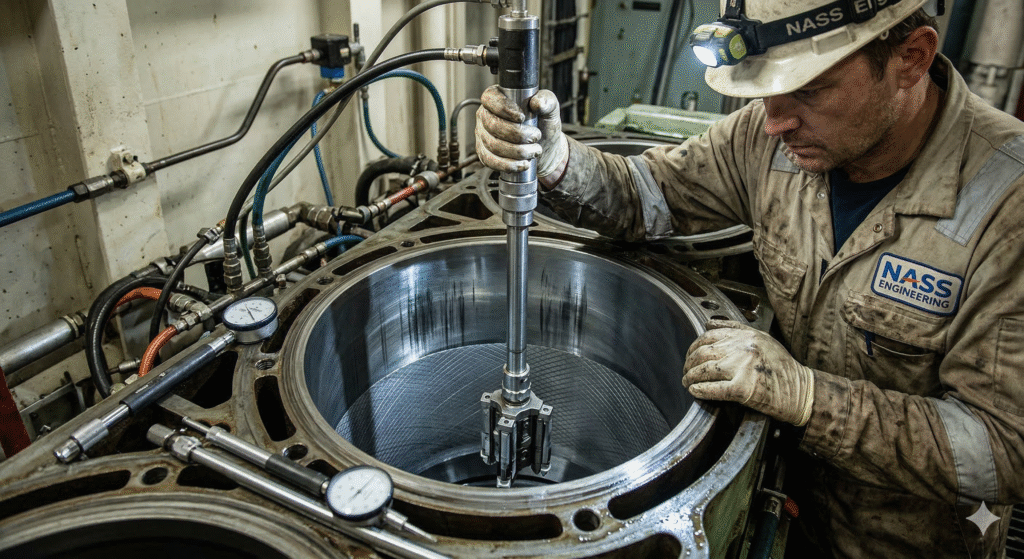
When a marine diesel engine begins losing compression or burning excessive lubricating oil, the root cause usually points to the cylinder liners. Over thousands of running hours, the constant friction between the piston rings and the liner wall degrades the internal surface. Under normal conditions, a healthy cylinder liner features a specific microscopic “crosshatch” pattern. These intersecting grooves are cut into the metal by the manufacturer to retain a thin film of lubricating oil. If that pattern wears away, the rings run dry against the metal, causing severe scuffing, loss of compression, and blow-by. Pulling an engine block apart to replace liners in a shipyard is a massive capital expense. However, if caught early, engineers can restore the liner’s surface using in-situ cylinder liner honing—a process executed while the vessel remains afloat. So, how do you know when it is time to deploy a riding squad? Here are the three exact mechanical indicators. 1. Scavenge Port Inspections Reveal “Mirror Glazing” The most immediate visual indicator of liner degradation occurs during a routine scavenge port inspection. When you bar the engine over and inspect the liner walls, you should see a dull, crosshatched finish. If the liner walls look highly polished, reflecting light like a mirror, the liner has “glazed.” Glazing happens when carbon deposits and degraded oil bake into the micropores of the metal, completely filling in the crosshatch grooves. Once a liner glazes, it can no longer hold oil. The piston rings will begin scraping directly against dry cast iron, leading to rapid wear and high friction temperatures. In-situ honing uses specialized abrasive stones to cut through the glaze and re-establish the correct grooves. 2. A Sudden Spike in Specific Lube Oil Consumption (SLOC) Fleet managers track Specific Lube Oil Consumption (SLOC) religiously because it directly impacts OPEX. If your SLOC metric suddenly spikes outside the engine builder’s baseline without any external leaks present, the oil is being burned in the combustion chamber. When the crosshatch pattern disappears, the oil control rings cannot scrape the excess oil off the smooth, glazed liner walls during the downward stroke. That oil is pushed up into the combustion space and burned. If your daily sounding logs show an unexplained increase in cylinder oil feed rates just to keep temperatures down, the liners require mechanical reconditioning. 3. Measurable Blow-By and Crankcase Pressure Alerts “Blow-by” occurs when the combustion gases bypass the piston rings and shoot downward into the crankcase. This happens because glazed or scuffed liners prevent the piston rings from seating properly and sealing the chamber. You will notice this issue through two distinct data points: Ignoring blow-by is highly dangerous. The hot combustion gases will quickly degrade the crankcase lubricating oil and, in severe cases, create the exact conditions required for a catastrophic crankcase explosion. The Data: Glazed Liners vs. OEM-Honed Liners To understand why honing is mandatory, look at the mechanical surface parameters. Our riding squads measure surface roughness (Ra) to determine if a liner requires in-situ machining. Here is the exact technical threshold we look for: Surface Parameter Healthy OEM-Honed Liner Degraded / Glazed Liner Mechanical Consequence Surface Roughness (Ra) 1.5 µm to 3.0 µm < 0.5 µm Complete loss of oil retention. Crosshatch Angle 30° to 45° intersecting 0° (Pattern wiped out) Rings hydroplane over the oil instead of scraping it. SLOC Baseline 0.8 to 1.2 g/kWh > 2.0 g/kWh Severe OPEX drain; heavy carbon buildup on piston crown. Friction Profile Boundary Lubrication Metal-to-Metal Contact Imminent risk of piston seizure and liner cracking. How NASS Engineering Executes In-Situ Honing Replacing cylinder liners requires heavy lifting gear, massive headroom, and usually a dry dock facility. NASS Engineering bypasses this by bringing the machine shop directly to the engine room. Our certified technicians deploy specialized, pneumatically driven honing rigs directly onto the engine block. We do not just blindly scrub the cylinder. We select specific grit stones (from roughing to finishing) to cut the exact 30-to-45-degree intersecting angle dictated by your specific engine manufacturer (whether it is a MAN B&W, Wärtsilä, or Caterpillar block). We execute these high-precision repairs during short port calls or at anchorage, feeding our core marine engineering services in UAE ports and our rapid-response hubs across the Middle East. By restoring the liner in place, we eliminate the need to order expensive replacement cast-iron liners, drastically reducing the total cost of your marine diesel engine overhaul. If your latest scavenge port inspection revealed polished liners, or your lube oil consumption is draining your operating budget, contact NASS Engineering to schedule a technical assessment and a targeted in-situ honing intervention.
OEM vs. Aftermarket Marine Engine Parts: The True Cost of OPEX Reduction
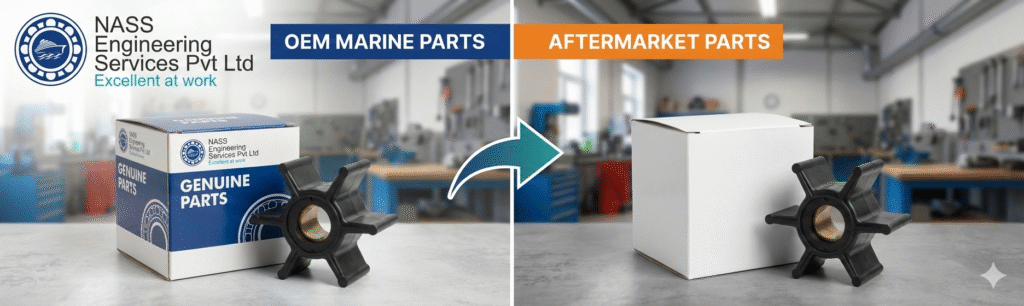
For modern fleet managers and chief engineers, reducing Operating Expenses (OPEX) is a daily mandate. When a major maintenance window approaches, the procurement department faces a critical decision: invest heavily in genuine Original Equipment Manufacturer (OEM) spares, or significantly cut costs by sourcing aftermarket alternatives. While non-OEM parts can offer immediate financial relief, applying them to critical marine propulsion systems often introduces hidden, long-term liabilities. The debate between OEM and aftermarket marine engine parts is not just about price—it is about balancing mechanical reliability, vessel safety, and legal compliance. Here is a data-driven look at when aftermarket parts make financial sense, and when compromising on genuine marine spares leads to catastrophic engine failure. The Financial Appeal of Aftermarket Spares The marine aftermarket industry is massive, primarily driven by the high cost and occasionally long lead times of OEM components. Third-party manufacturers often reverse-engineer parts for major engine brands like Caterpillar, Cummins, Detroit Diesel, and Rolls-Royce Bergen. For non-critical applications, high-tier aftermarket parts (often referred to as “OEM-equivalent”) can perform adequately. These are typically used in auxiliary systems where a sudden component failure does not immediately threaten the vessel’s propulsion, steering, or electrical generation. Where Aftermarket Parts Are Commonly Considered: However, the cost-saving argument collapses when dealing with the high-stress, high-temperature environment of the main engine’s combustion chamber. The Danger Zone: When Non-OEM Spares Lead to Catastrophic Engine Failure Marine diesel engines operate under extreme mechanical tolerances. A deviation of just a few micrometers in a machined component can disrupt the entire operational harmony of the engine. When fleet managers authorize the use of aftermarket parts for critical systems, they risk the following mechanical failures: Classification Society Compliance & Insurance Risks Beyond mechanical reliability, the OEM vs. aftermarket debate carries severe legal and financial implications. Major maritime insurance policies and Classification Society standards (such as ABS, DNV, and IRS) require vessels to be maintained in a seaworthy condition using approved components. If a vessel loses propulsion in a high-traffic zone (like the Strait of Hormuz) and causes an incident, the subsequent root-cause investigation will scrutinize the engine’s maintenance logs. If investigators determine that a non-approved aftermarket part caused the failure, the vessel’s insurance claim may be voided entirely due to non-compliance. Sourcing verified, genuine components is just as much about legal protection as it is about mechanical performance. The NASS Engineering Verdict: Strategic Sourcing for Peak Reliability At NASS Engineering, our priority is zero unplanned downtime for our clients. While we understand the pressure to optimize procurement budgets, we draw a hard line when it comes to the core mechanics of main propulsion and power generation. When our certified technicians execute a scheduled marine diesel engine overhaul, we strictly utilize OEM-standard tolerances. We advise fleet managers to prioritize genuine components for all moving parts, fuel delivery systems, and internal cooling mechanisms. For vessels requiring rapid, reliable procurement, we assist in sourcing verified marine spare parts globally, ensuring that every component installed meets exact manufacturer specifications. Whether you require parts supply or are deploying our riding squads for emergency marine engineering services in UAE ports, prioritizing component integrity is the only proven method for long-term OPEX reduction. Frequently Asked Questions (FAQ)
Marine Riding Squads — Engine Repair & Maintenance at Global Ports
Marine operations rarely fail at convenient times or locations. Engine issues often occur mid-voyage or at unfamiliar ports, where delays translate directly into off-hire costs, missed schedules, and operational risk. This is where marine riding squads play a critical role in maintaining vessel reliability. Marine riding squads provide on-board engine repair and maintenance support at global ports, allowing corrective and preventive work to be carried out without waiting for dry docking or shipyard availability. When deployed correctly, riding squads reduce downtime, stabilize engine performance, and keep vessels operational across international trade routes. What Are Marine Riding Squads? Marine riding squads are specialized engineering teams deployed to vessels while they are in operation or temporarily alongside at port. Unlike shipyard-based repairs, riding squads: Their primary objective is to restore or maintain operational reliability without disrupting voyage schedules. When Are Riding Squads Required? Riding squads are typically deployed under time-critical or operationally constrained conditions. Common scenarios include: In many cases, riding squads prevent small issues from escalating into major failures. Scope of Work Performed by Marine Riding Squads Engine Repair and Maintenance The core focus of most riding squads is main and auxiliary engine reliability. Typical tasks include: Work is prioritized based on risk and available time. Condition Monitoring and Diagnostics Riding squads rely heavily on diagnostics to make accurate decisions quickly. Engineering assessments may include: Data-driven diagnostics allow engineers to target the root cause instead of applying temporary fixes. Support During Voyage or Port Stay Depending on vessel schedules, riding squads may: This flexibility is what makes riding squads valuable for global operations. Advantages of Marine Riding Squads at Global Ports Reduced Downtime By addressing issues immediately, riding squads: Time saved directly translates into cost savings. Cost Control Riding squad interventions often: Planned riding squad work is usually more economical than reactive breakdown repairs. Global Operational Flexibility Global riding squad capability ensures: This is especially important for vessels operating across regions and time zones. Challenges in Riding Squad Operations While effective, riding squad operations come with constraints that require experience to manage. Common challenges include: Experienced engineering teams plan interventions carefully to maximize impact within these limits. Integration with Planned Maintenance and Dry Docking Riding squads do not replace dry docking or major overhauls. Instead, they complement them. Effective integration allows: Riding squad findings often inform long-term maintenance strategies. Best Practices for Successful Riding Squad Deployment From an engineering perspective, successful riding squad operations follow clear principles: Execution discipline is critical in time-limited environments. Role of Riding Squads in Modern Marine Operations As vessels operate under tighter schedules and higher efficiency demands, riding squads have become an essential part of modern marine maintenance strategies. They enable: Riding squads bridge the gap between emergency repair and planned maintenance. Marine riding squads often operate as part of a broader maintenance and reliability strategy rather than as a standalone solution. For major corrective work beyond on-board limits, a planned marine engine overhaul ensures long-term performance recovery and controlled downtime. Advanced diagnostics such as vibration analysis are frequently used by riding squads to identify imbalance, misalignment, and early-stage mechanical faults before they escalate. Precision tools like laser alignment play a critical role during onboard reinstallation and commissioning, especially after component replacement or corrective repairs. When riding squad interventions are aligned with the overall dry docking process, vessel operators can significantly reduce unexpected scope and delays during scheduled dockings. Conclusion Marine riding squads provide a practical and effective solution for engine repair and maintenance at global ports. By delivering skilled engineering support directly on board, they help vessel operators maintain reliability, control costs, and avoid unnecessary downtime. When integrated into a broader maintenance strategy, riding squads enhance operational resilience across worldwide marine operations.
Bergen Marine Engine Maintenance & Overhaul — Engineering Best Practices
Bergen marine engines are widely used in offshore vessels, ferries, and power-critical marine applications where reliability and load response are non-negotiable. Known for their robust construction and fuel efficiency, these engines still require disciplined maintenance and correctly planned overhauls to deliver long-term performance. This article explains engineering best practices for Bergen marine engine maintenance and overhaul, focusing on condition-based decision-making, failure prevention, and lifecycle reliability rather than reactive repair. Understanding Bergen Marine Engine Operating Characteristics Bergen Engines engines typically operate under demanding conditions such as variable load profiles, continuous running hours, and harsh marine environments. Key characteristics that influence maintenance planning include: These characteristics make engineering-led maintenance essential. Importance of Structured Maintenance Planning Unstructured or calendar-only maintenance often leads to: Best practice maintenance is based on: This approach allows maintenance actions to be planned rather than forced by failure. Routine Maintenance Best Practices Lubrication System Management Lubrication is one of the most critical factors in Bergen engine reliability. Best practices include: Ignoring oil health is one of the fastest paths to bearing and liner damage. Cooling System Maintenance Cooling inefficiencies directly impact combustion stability and component life. Engineering focus areas: Stable cooling ensures consistent engine performance under load. Fuel System Health Fuel system issues often manifest as power loss, rough running, or increased exhaust temperatures. Maintenance should include: Precision in fuel delivery directly affects engine efficiency and emissions. Condition Monitoring and Diagnostics Modern Bergen engine maintenance relies heavily on diagnostics rather than assumptions. Key monitoring methods include: Condition monitoring helps identify developing faults before they cause secondary damage. Techniques such as vibration analysis play a critical role in identifying imbalance, misalignment, and early-stage mechanical defects. When Is Overhaul Required? Overhaul should never be triggered by failure alone. Engineering indicators for overhaul include: Planned overhauls reduce downtime and protect critical components. In such cases, a planned marine engine overhaul helps restore performance while minimizing unplanned downtime and secondary damage. Bergen Marine Engine Overhaul Best Practices Pre-Overhaul Engineering Assessment Before any overhaul: This avoids unnecessary dismantling and cost escalation. Component-Level Inspection and Repair During overhaul, attention should be given to: Precision measurement and proper tolerances are critical. Alignment and Reinstallation Post-overhaul alignment errors are a common cause of premature failures. Best practices include: Mechanical precision directly impacts service life. Using precision laser alignment during reinstallation significantly reduces bearing loads and prevents premature mechanical failures. Post-Overhaul Testing and Validation An overhaul is incomplete without validation. Testing should include: Validation confirms overhaul quality and prevents early-life failures. Integration with Dry Dock and Major Maintenance Windows Bergen engine overhauls are often planned during major maintenance windows such as dry docking. Coordinating engine overhaul with other ship systems allows: Integrated planning improves overall vessel readiness. Understanding the broader dry docking process allows engine overhauls to be aligned effectively with hull, propulsion, and auxiliary system work. Long-Term Reliability Strategy Sustainable Bergen engine performance depends on: Reactive maintenance shortens engine life. Planned maintenance extends it. Conclusion Bergen marine engine maintenance and overhaul demand an engineering-driven approach that prioritizes data, precision, and planning. When maintenance is structured and overhauls are executed methodically, Bergen engines deliver predictable performance, extended service life, and reduced lifecycle cost. Reliability is not achieved during repair. It is built through disciplined maintenance and informed overhaul decisions.
Dry Dock Planning for Ships — Engineering Preparation, Timelines & Risk Control

Dry dock planning is the most decisive phase in a vessel’s maintenance cycle. Long before a ship enters the dock, the quality of planning determines whether the dry dock period will be efficient, cost-controlled, and technically successful, or delayed, over-budget, and reactive. From a marine engineering perspective, dry dock planning is not an administrative task. It is a structured technical process that aligns vessel condition, repair scope, timelines, manpower, and compliance requirements into a single executable plan. This guide explains how professional dry dock planning is carried out, what engineering inputs are required, and how risks and delays can be controlled before docking begins. Why Dry Dock Planning Is Critical Most dry dock failures do not occur inside the dock. They originate weeks or months earlier due to poor preparation. Inadequate planning leads to: Well-planned dry docking, on the other hand, allows vessel owners to control cost, reduce downtime, and return the ship to service with predictable performance. A clear understanding of the dry docking process allows planners to align technical scope, timelines, and resources well before the vessel enters dock. Pre-Dry Dock Engineering Assessment Dry dock planning begins with understanding the true condition of the vessel. Hull and Structural Assessment Before docking, engineers should review: Where required, preliminary underwater inspections help identify potential structural work and steel renewal needs. Machinery Health Review Machinery planning is often underestimated during dry dock preparation. Engineering review should include: This allows maintenance tasks to be planned instead of discovered late. Accurate assessment ensures that major tasks such as marine engine overhaul are planned rather than discovered during dock inspection. Propulsion and Performance Data Review Planning should consider: Using existing performance data reduces surprises during inspection. Reviewing historical data allows planners to schedule critical propulsion system maintenance without disrupting the dry dock timeline. Dry Dock Scope Definition Clear scope definition is the backbone of dry dock planning. Mandatory Scope This includes: These items are non-negotiable and must be planned early. Planning decisions directly influence the effectiveness of subsequent dry dock ship maintenance activities carried out during execution. Optional and Preventive Scope Engineering teams should also identify: Including preventive work during planned docking is almost always more economical than emergency repairs later. Scope Prioritization Not all work carries equal risk. Critical items should be prioritized based on: This ensures limited dock time is used effectively. Dry Dock Timeline Planning Time management is one of the most sensitive aspects of dry dock planning. Pre-Dock Timeline Planning should begin well in advance and include: Late planning almost always results in schedule compression and errors. Docking Phase Timeline The docking period itself should be broken into phases: Each phase should have clear responsibility and sequencing. Buffer and Contingency Planning Engineering-led planning always includes buffers for: Ignoring contingencies leads to unrealistic schedules. Risk Identification and Control Risk management is a key differentiator between average and professional dry dock planning. Planning for precision laser alignment during reinstallation minimizes bearing stress and reduces the risk of premature failures after docking. Common Dry Dock Risks Typical risks include: Most of these risks are predictable with experience. Incorporating post-repair vibration analysis into the plan helps verify alignment quality and detect hidden installation issues early. Risk Mitigation Strategies Effective mitigation includes: Engineering involvement at the planning stage reduces reactive decision-making. Cost Planning and Budget Control Dry dock cost overruns usually stem from scope uncertainty. Planned vs Unplanned Cost Planned costs are predictable.Unplanned costs emerge from: Dry dock planning aims to convert unplanned cost into planned cost. Well-defined planning significantly reduces unexpected work during dry dock ship repair, helping control both timelines and overall cost. Engineering-Driven Cost Optimization Cost control does not mean cutting work.It means: Quality planning reduces total lifecycle cost. Role of Engineering Partners in Dry Dock Planning Dry dock planning benefits significantly from early involvement of experienced marine engineering teams. Engineering partners contribute by: Early engineering input reduces execution-stage surprises. Best Practices for Successful Dry Dock Planning From field experience, the following practices consistently improve outcomes: Dry dock success is decided on paper before steel is cut. Relationship Between Planning and Execution Dry dock planning does not replace execution.It enables it. Well-planned docking leads to: Execution quality reflects planning quality. Conclusion Dry dock planning for ships is a technical discipline, not a scheduling exercise. It combines engineering assessment, scope definition, timeline control, and risk management into a structured process that protects both vessel performance and investment. When planning is approached systematically and supported by engineering expertise, dry docking becomes a controlled maintenance activity rather than a reactive repair event. Strong dry dock planning is the foundation of reliable ship operations.
