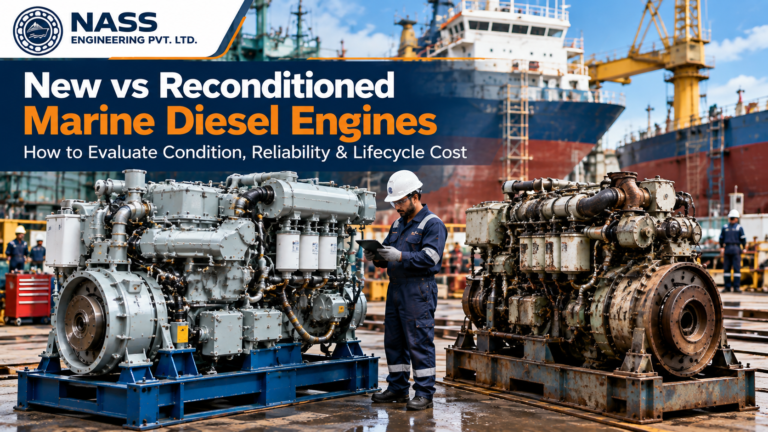
Choosing between a new marine diesel engine and a reconditioned engine is not simply a question of purchase price. The decision affects installation planning, downtime, spare-parts availability, expected service life, documentation, warranty arrangements and the overall maintenance strategy of the vessel.
NASS Engineering Services Pvt. Ltd. lists New and Reconditioned Engines within its ship engine spare-parts portfolio. The company’s marine engineering business also covers diesel engine inspection, troubleshooting, repair and overhaul across multiple engine makes, which means an engine replacement decision can be considered alongside the condition of the existing machinery.
This guide explains the difference between a new engine, a reconditioned engine and an OEM remanufactured engine, what should be checked before purchase, and how vessel operators can compare the options on a lifecycle basis.
New, Reconditioned and Remanufactured Engines: What Is the Difference?
New Marine Diesel Engine
A new engine is manufactured as a new production unit according to the original manufacturer’s current specifications and configuration. The exact equipment supplied, included auxiliaries, control system, warranty and support package depend on the manufacturer and the specific engine order.
Reconditioned Marine Diesel Engine
A reconditioned engine is a previously used engine or major engine assembly that has undergone inspection, cleaning, measurement and repair or replacement of components as required by the reconditioning program. The scope can vary significantly between suppliers.
For that reason, the word reconditioned should never be treated as a complete technical specification by itself. A buyer should ask for the engine identification, work scope, component measurements, parts replaced, test results, operating history where available and warranty terms.
OEM Remanufactured Engine
OEM remanufacturing is a defined manufacturer process and should be distinguished from a generic reconditioned engine. For example, Caterpillar states that its Cat Reman engines and components are disassembled, inspected, cleaned, repaired or remanufactured as required, and tested to deliver like-new performance. Caterpillar also states that its marine Reman portfolio includes complete engines, long blocks and short blocks. Caterpillar’s current Cat Reman information describes its process, coverage, testing and warranty terms.
An OEM remanufactured engine therefore should not automatically be assumed to be the same thing as any used engine described as reconditioned. The process, specifications, traceability, testing and warranty must be evaluated.
When Does Replacing a Marine Engine Make Sense?
Replacement becomes a practical option when the existing engine condition, repair scope, operating requirements or availability of major components make continued overhaul less suitable for the vessel.
Typical decision points include:
- Repeated major failures or recurring reliability problems
- Significant wear in the block, crankshaft or cylinder assembly
- High repair scope combined with long expected downtime
- Difficulty obtaining critical replacement components
- Changes in the vessel’s power or operating requirements
- A planned machinery renewal or major refit
There is no universal replacement threshold. The decision should be based on the measured condition of the existing engine, the expected repair scope, the vessel’s operating profile and the technical alternatives available.
New vs Reconditioned Marine Engine: Key Comparison
| Factor | New Engine | Reconditioned Engine |
|---|---|---|
| Initial purchase cost | Generally higher | Can be lower, depending on engine and reconditioning scope |
| Equipment history | New production unit | Usually has a previous operating history, which should be documented where available |
| Condition assessment | Factory production and testing records apply | Inspection and reconditioning records are critical |
| Lead time | Depends on manufacturer and availability | Depends on stock and completed reconditioning scope |
| Warranty | Depends on manufacturer and supplier | Depends on the reconditioner or supplier |
| Documentation | Factory documentation is normally available | Ask for detailed reconditioning and test documentation |
| Lifecycle cost | Must include purchase, installation and future maintenance | Must include purchase, verification, installation and expected maintenance |
What to Check Before Buying a Reconditioned Marine Engine
The most important protection for a buyer is technical documentation. A low price without clear engine history and inspection evidence can make a supposedly economical purchase difficult to evaluate.
1. Engine Identification
Record the manufacturer, exact model, engine serial number, configuration and available nameplate information. Make sure these details match the documentation supplied with the engine.
2. Operating History
Where available, review running hours, previous overhaul records, applications, maintenance history and major component replacements. A complete maintenance record provides much more information than a statement that an engine has been overhauled.
3. Block and Main Structure
The block should be assessed for cracks, damage, corrosion and dimensional condition. Depending on the engine, precision measurements may be required before deciding which components can be reused.
4. Crankshaft
Crankshaft condition is central to engine reliability. Journal dimensions, surface condition, runout and other relevant measurements should be verified against the manufacturer’s applicable limits.
NASS Engineering provides crankshaft grinding as part of its precision marine engine services, which can be relevant when a crankshaft requires controlled reconditioning during an overhaul.
5. Cylinder Heads and Liners
Check cylinder-head condition, liner dimensions and surface condition, together with piston and ring condition where applicable. Measurements are more useful than visual inspection alone.
NASS Engineering also provides in-situ liner honing, a service that can restore a cylinder-liner surface when the engineering assessment shows honing is appropriate.
6. Bearings and Clearances
Main and connecting-rod bearings should be checked as applicable to the engine design. Clearance values should be documented against the manufacturer’s specifications rather than accepted on visual appearance alone.
7. Fuel Injection Equipment
Fuel injectors and injection pumps can have a major effect on combustion and engine performance. Ask whether the equipment has been tested, calibrated or replaced and request the associated records.
NASS Engineering lists Bosch fuel injection systems as part of its product offering and provides injector and fuel-pump related technical support.
8. Turbocharger
The turbocharger should be evaluated for rotor condition, bearings, seals, clearances and balance according to the relevant manufacturer procedure.
NASS Engineering provides turbocharger overhaul and lists rotor balancing and bearing renewal among its capabilities.
Testing a Reconditioned Engine Before Installation
Testing requirements depend on the engine, supplier and application, but a buyer should request documented evidence of the tests performed.
Useful documentation can include:
- Inspection and measurement reports
- Parts replaced or reconditioned
- Fuel-system test or calibration records where applicable
- Lubrication and cooling-system checks
- Compression or other applicable engine test results
- Run-test or dynamometer records where such testing is part of the supplier’s process
- Final assembly and inspection records
- Warranty documentation
Caterpillar, for example, states that Cat Reman complete engines are dynamometer tested and tuned for like-new performance and fuel efficiency. This illustrates why a buyer should ask exactly what testing a supplier has performed rather than assuming that every reconditioned engine has undergone the same process.
Why Documentation Matters in Marine Engine Procurement
Engine replacement is a technical procurement decision. The engine must match the vessel’s propulsion or power-generation requirements and the surrounding installation.
Important records can include:
- Engine model and serial number
- Performance and rating information
- Configuration details
- Previous maintenance records
- Reconditioning scope
- Measurement sheets
- Test reports
- Parts records
- Warranty terms
- Installation and commissioning requirements
For regulated vessels, additional class, flag-state, owner or equipment-specific requirements may apply. These should be identified before procurement rather than after the replacement engine reaches the vessel.
New Engine vs Reconditioned Engine: Think in Lifecycle Cost
The purchase price is only one component of the total cost of an engine replacement.
A useful comparison should include:
- Engine purchase cost
- Transportation and logistics
- Removal of the existing engine
- Installation and alignment
- Auxiliary equipment compatibility
- Commissioning and testing
- Spare-parts requirements
- Expected maintenance scope
- Warranty coverage
- Potential future downtime
A reconditioned engine with strong documentation and an appropriate test program may be a practical option for some vessels. A new engine may be more suitable where the owner requires a new production unit or where the technical and lifecycle requirements justify the higher initial capital cost.
Engine Replacement Can Involve More Than the Engine
Installing a replacement engine may require work beyond the engine itself. Foundation condition, coupling, shaft alignment, exhaust connections, cooling circuits, fuel systems, controls, electrical interfaces and instrumentation may all need to be checked against the replacement configuration.
NASS Engineering provides laser alignment and vibration analysis, which can be useful when machinery alignment or post-installation vibration needs to be investigated.
Where the vessel is already scheduled for docking, engine replacement can also be coordinated with the broader dry dock ship repair and refit scope.
Engine Brands Supported by NASS Engineering
NASS Engineering states that its marine diesel engine teams work with a range of engine makes and models. Its published service and spare-parts information includes:
- Rolls-Royce / Bergen
- Caterpillar
- Detroit
- EMD
- MaK
- Cummins
- Yanmar
- Niigata
- MAN / MAN B&W
- Wärtsilä
- MTU
- Daihatsu
- Kirloskar
- Ruston
- Perkins
- Volvo Penta
- Lister Petter
- Waichai
The company also has dedicated content and product information around Caterpillar 3412 marine engines and Bergen engine spare parts. Its spare-parts page lists Caterpillar models including 3516B, 3512 and 3412, and Bergen series including KRMB, KRM, KVM, KRG, KVG, BR, BV and C25:33.
Where NASS Engineering Fits Into the Replacement Decision
An engine replacement program can involve procurement, inspection, mechanical preparation, installation, alignment, testing and ongoing parts support. NASS Engineering’s service portfolio spans several of these areas.
The company lists:
- Diesel engine inspection, troubleshooting, repair and overhaul
- Crankshaft grinding
- Engine block line boring
- Turbocharger overhaul
- Governor overhaul
- In-situ liner honing
- Laser alignment
- Vibration analysis
- Marine gearbox services
- Diesel engine spare parts
- New and reconditioned engines
That combination is useful when the question is not simply “which engine should we buy?” but “should we repair, rebuild or replace the existing engine, and what additional work will be required to return the vessel to service?”
Questions to Ask Before Purchasing a Reconditioned Engine
- What is the exact engine model and serial number?
- What was the engine’s previous application and operating history?
- What components were replaced?
- What components were reconditioned?
- Which measurements were taken?
- Which manufacturer specifications were used?
- What testing was completed?
- Are test reports available?
- What warranty is included?
- Are the engine’s accessories and controls included?
- What commissioning support is available?
- Are critical spare parts available after installation?
India and International Marine Support
NASS Engineering Services Pvt. Ltd. lists its head office and workshop in Navi Mumbai, Maharashtra, India. The company also lists a Visakhapatnam branch and a Kolkata branch and workshop, together with overseas entities in Ras Al Khaimah, United Arab Emirates, and Dammam, Saudi Arabia. Its website also highlights marine engineering port coverage in Saudi Arabia, the UAE and Qatar.
For an engine replacement or reconditioned-engine requirement, the practical service plan depends on vessel location, engine model, available installation facilities, delivery schedule and the technical work required.
Conclusion
The choice between a new marine diesel engine and a reconditioned engine should be based on technical condition, documentation, expected operating requirements and lifecycle cost, not purchase price alone.
A new engine provides a new production unit, while a reconditioned engine can provide another operating option when its condition, reconditioning scope, testing and documentation are clearly established. OEM remanufactured products form a separate category with a defined manufacturer’s process, such as the Cat Reman program described by Caterpillar.
For vessel operators considering repair versus replacement, NASS Engineering combines marine engine troubleshooting, overhaul, precision machining, diagnostics, spare-parts supply and new and reconditioned engine support. The right decision still depends on the specific engine, vessel, operating profile and technical evidence available.
Meta Information
Meta Title: New vs Reconditioned Marine Diesel Engines | NASS Engineering
Meta Description: Compare new and reconditioned marine diesel engines, including inspection, testing, documentation, lifecycle cost, installation and NASS Engineering support.