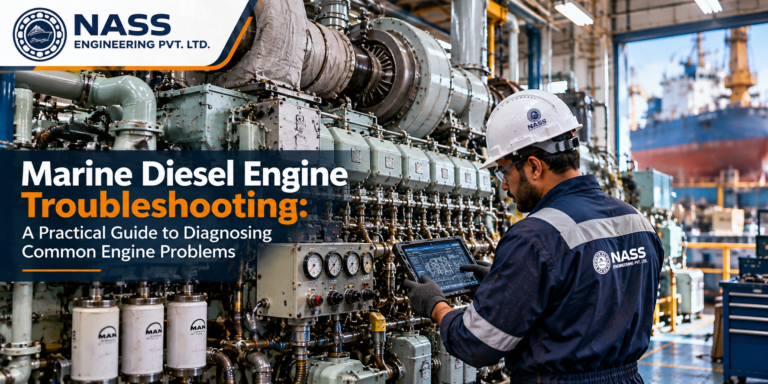
Marine diesel engine troubleshooting is most effective when engineers work from symptoms, operating data and inspection evidence rather than replacing parts based on a single indication. A loss of power, rising exhaust temperature, excessive smoke, difficult starting or abnormal vibration can have several possible causes, and the correct diagnosis depends on the engine model, load condition, maintenance history and measured data.
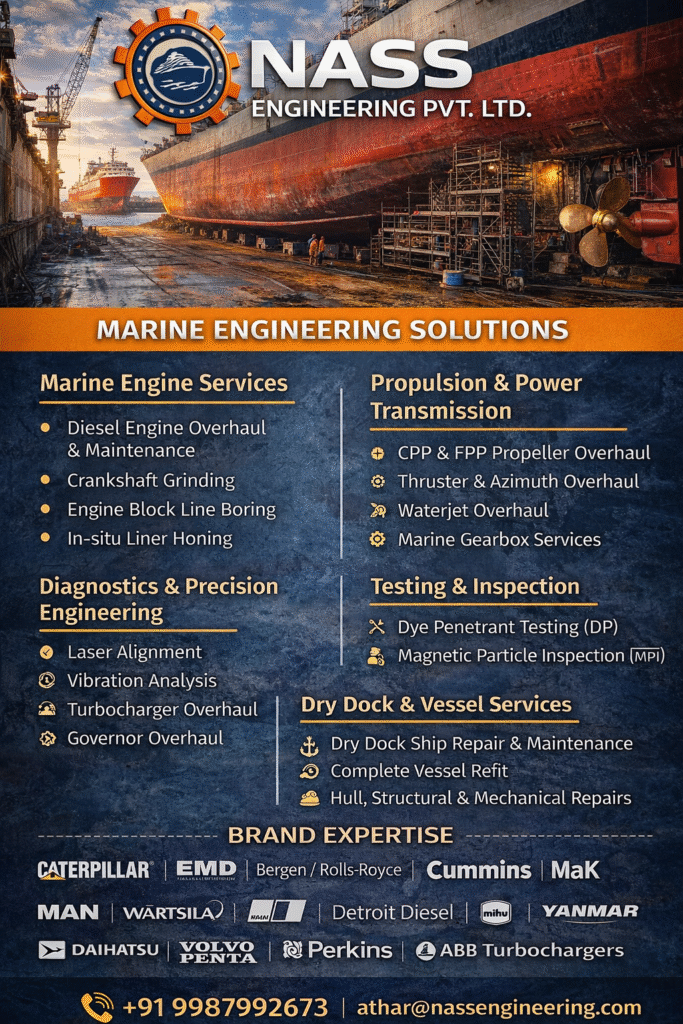
NASS Engineering Services Pvt. Ltd. provides diesel engine troubleshooting, inspection, repair and overhaul for marine engines and states that its teams support engines onboard vessels, at docks and in other operating environments. Its listed experience includes Rolls-Royce/Bergen, Caterpillar, Detroit, EMD, MaK, Cummins, Yanmar, Niigata and other engine makes and series.
This guide provides a structured approach to common marine diesel engine symptoms and shows where diagnostics, component inspection and planned maintenance can fit into the troubleshooting process.
Why Marine Diesel Engine Troubleshooting Should Start With the Symptom
A diesel engine rarely develops a problem in isolation. Fuel injection, combustion, lubrication, cooling, air supply, exhaust flow, mechanical condition and connected equipment all influence engine behavior.
For example, loss of power may be associated with a fuel-delivery problem, restricted air supply, turbocharger condition, cooling limitation, injection timing, mechanical wear or an operating-control issue. Treating every power-loss complaint as a fuel-system problem can result in unnecessary component replacement.
A better troubleshooting process begins by defining exactly what changed and under what operating conditions the change occurs.
Marine Diesel Engine Troubleshooting Checklist
- Record the engine model and running hours
- Review recent maintenance and repair history
- Record alarms and abnormal indications
- Compare current readings with the engine’s normal operating baseline
- Check load, speed and operating conditions when the symptom occurs
- Inspect fuel, lubrication, cooling and air systems
- Use appropriate measurement and condition-monitoring methods
- Confirm the root cause before replacing major components
- Document the diagnosis, corrective work and verification results
1. Engine Has Lost Power
Loss of power is one of the most common reasons for marine diesel engine troubleshooting. Before dismantling the engine, engineers should establish whether the loss occurs across the complete operating range or only at a particular load or speed.
Possible Areas to Investigate
- Fuel supply and fuel filtration
- Fuel injector or pump condition
- Air intake restriction
- Turbocharger performance
- Exhaust system condition
- Cooling-system performance
- Combustion and cylinder condition
- Governor or engine-control system
NASS Engineering’s marine engine service portfolio includes troubleshooting and repair as well as complete top and major overhauls. Where the preliminary checks indicate internal wear, more detailed inspection can be planned instead of immediately assuming that a complete overhaul is required.
2. Excessive Black Smoke
Black smoke generally indicates incomplete combustion or excessive fuel relative to the available air under the operating condition. The actual cause must be determined from the engine design and measured operating data.
Areas to Check
- Fuel injector spray and condition
- Fuel pump performance
- Air filters and intake restriction
- Turbocharger condition and boost
- Exhaust restrictions
- Engine loading and operating profile
NASS Engineering also supports Bosch fuel-injection requirements and lists injector testing and calibration and fuel-pump repair and reconditioning as technical services associated with its Bosch offering.
3. White or Blue Smoke
The color and timing of smoke can provide useful diagnostic information, but smoke color should not be used as a standalone diagnosis.
White exhaust can be associated with incomplete combustion, particularly during starting or abnormal operating conditions, while blue smoke can be associated with lubricating-oil consumption. Engineers should consider coolant condition, cylinder temperature, compression, injector condition, liner and ring condition, and operating temperature when investigating persistent smoke.
Where cylinder-liner condition is suspected, NASS Engineering provides in-situ cylinder liner honing using specialized tools. The need for honing should be established from actual liner condition and the applicable service limits.
4. High Exhaust Temperature
A high exhaust temperature indication should be investigated promptly because the cause may involve combustion, fuel injection, air supply, cooling or mechanical condition.
Diagnostic Checks
- Compare individual cylinder exhaust temperatures
- Check injector and fuel-system condition
- Check charge-air and turbocharger performance
- Review cooling-water temperatures and flow
- Inspect exhaust passages where appropriate
- Check for changes from the engine’s historical baseline
A difference between cylinders can be particularly useful because it may help narrow the investigation toward an individual cylinder or component.
5. Low Lubricating-Oil Pressure
Low oil pressure is a critical indication and should be investigated according to the engine manufacturer’s procedures and operating limits.
Possible areas include:
- Oil level and oil condition
- Oil filter condition
- Oil-pump performance
- Pressure-relief components
- Oil cooler condition
- Internal leakage or bearing clearances
- Instrument or sensor accuracy
Oil condition is also relevant to long-term engine wear. NASS Engineering’s marine engineering portfolio includes ENI lubricants and MANN+HUMMEL centrifugal filtration products for marine and offshore applications.
6. Engine Overheating
Cooling-system problems can develop gradually and may first appear as rising temperatures under high load.
Common Inspection Areas
- Coolant level and condition
- Seawater flow where applicable
- Seawater strainers
- Cooling pumps
- Heat exchangers
- Thermostatic and control components
- Leaks and abnormal pressure conditions
Cooling performance should be assessed against the engine manufacturer’s specified operating range. A general temperature number should not be applied to every marine diesel engine.
7. Difficult Starting
Difficult starting can result from several systems. Engineers should first identify whether the engine turns at the correct cranking speed and then determine whether the problem is associated with fuel delivery, air, compression, starting controls or another system.
Initial Checks
- Starting-air or starting-system condition
- Fuel supply and pressure
- Fuel filters and water separation
- Injector and pump condition
- Compression condition
- Engine-control and shutdown systems
- Battery and electrical starting systems where applicable
Repeated difficult starting should be investigated systematically rather than treated as normal aging.
8. Excessive Engine Vibration
Vibration can originate inside the engine or in connected machinery. Possible sources include combustion imbalance, mechanical wear, mounting problems, coupling condition, shaft alignment and propulsion-system issues.
NASS Engineering provides vibration analysis as one of its condition-monitoring techniques. Vibration measurements can help identify changes from an established baseline and can be combined with temperature, operating data and inspection findings.
9. Turbocharger-Related Problems
Turbocharger condition has a direct relationship with the air supply available to a turbocharged diesel engine. Fouling, bearing problems, rotor imbalance, lubrication issues, exhaust-side restrictions or other faults can affect turbocharger performance.
Potential signs include:
- Reduced boost or loss of engine response
- Unusual turbocharger noise
- Abnormal vibration
- Rising exhaust temperatures
- Increased smoke
NASS Engineering provides turbocharger overhaul and states that its service includes rotor balancing and bearing renewal for ABB turbochargers.
10. Fuel Injection Problems
Fuel injection directly affects combustion quality. Injector wear, poor spray formation, fuel-pump problems, contamination or incorrect calibration can change combustion behavior and engine performance.
NASS Engineering’s Bosch offering includes fuel injectors, fuel pumps and complete injection systems, together with injector testing and calibration and fuel-pump repair and reconditioning.
For further reading, see the existing NASS Engineering article on marine fuel injector failures.
11. Abnormal Oil Consumption or Blow-By
An increase in lubricating-oil consumption or blow-by should be investigated using the engine’s operating history and measured condition. Possible areas include cylinder liners, piston rings, pistons, valve guides and other components depending on the engine design.
NASS Engineering provides in-situ liner honing and describes the service as a method used to restore the running surface of cylinder liners. The correct repair approach should be established from liner measurements, surface condition and applicable manufacturer limits.
When Troubleshooting Indicates the Need for an Overhaul
Troubleshooting does not automatically mean that an engine requires a complete overhaul. A major overhaul becomes more appropriate when inspection and measurements show significant internal wear, repeated component problems, poor compression, excessive oil consumption, persistent performance loss or other conditions that cannot be corrected through routine maintenance.
NASS Engineering provides both marine diesel engine overhaul and troubleshooting services. Its listed overhaul-related capabilities also include crankshaft grinding, engine block line boring and other precision engineering work.
Using Condition Monitoring to Improve Troubleshooting
Condition monitoring helps engineers move from isolated observations to measurable trends. Vibration, temperature, oil condition and other parameters can be compared against established operating baselines.
NASS Engineering provides laser alignment and vibration analysis as condition-monitoring services. Where an engine or propulsion system has a recurring vibration problem, alignment measurements can help determine whether the source is mechanical alignment rather than an internal engine fault.
Marine Engine Troubleshooting by Engine Brand and Model
Diagnostic procedures must always be adapted to the engine model. NASS Engineering states that its service team works with several marine diesel engine makes and series, including:
- Rolls-Royce / Bergen: KRMB-8, KRMB-9, KVMB-12, KVMB-16, B32:36, B32:40 and C25:33
- Caterpillar: 3516B, 3512, 3412, 3408, 3406, 3306, D399, D398, C32, C18, C11 and C9
- Detroit: 4-71, 6-71, 8V71, 12V71, 8V92, 16V92 and 60 Series
- EMD: 645 and 710 Series
- MaK: 8M20C, 8M25C, 8CM32 and 8M43C
- Cummins: 6BTA, QSK50, KT19, QSM and NTA855
- Yanmar: 6N165, 6EY18, 6EY22, 6EY26 and 6EY33
- Niigata: MG17HX, MG19HX, MG22HX, MG25HX, MG26HLX, MG28HX, MG28HLX, MG28AHX and MG31HX
The company also lists experience with Daihatsu, MTU, Wärtsilä, MAN, Kirloskar, Yamaha outboard engines, Perkins, Leyland, Volvo Penta, Lister Petter and Waichai.
When Should You Call a Marine Engine Troubleshooting Team?
Professional support is appropriate when the symptom is persistent, the cause is not clear, the engine is operating outside normal limits, or continued operation could result in consequential damage.
Early technical assessment can be especially useful when:
- Engine power has changed without an obvious operating reason
- Exhaust temperatures are persistently abnormal
- Oil pressure or consumption has changed
- Vibration has increased
- Smoke has changed from the normal operating condition
- Repeated component failures are occurring
- The vessel is approaching a planned maintenance or dry dock period
Marine Engine Troubleshooting Support from NASS Engineering
NASS Engineering provides marine diesel engine troubleshooting, inspection, repair and overhaul support. Its wider technical services include turbocharger overhaul, governor overhaul, crankshaft grinding, engine block line boring, in-situ liner honing, laser alignment, vibration analysis and NDT.
The company states that its engineers and technicians handle engine work onboard vessels, at docks and in other marine and industrial environments. Its listed company locations include Navi Mumbai, Visakhapatnam and Kolkata in India, as well as Ras Al Khaimah in the United Arab Emirates and Dammam in Saudi Arabia. The website also highlights marine engineering port coverage in Saudi Arabia, the UAE and Qatar.
Final Takeaway
Marine diesel engine troubleshooting works best when it is treated as a diagnostic process rather than a parts-replacement exercise. Engine symptoms need to be connected with operating data, inspection results and the specific design of the equipment.
Fuel injection, lubrication, cooling, air supply, turbocharger performance, cylinder condition, vibration and alignment can all affect engine behavior. Establishing the root cause before major repair helps reduce unnecessary work and provides a stronger basis for deciding whether routine maintenance, component repair or a complete overhaul is appropriate.
NASS Engineering supports marine diesel engine troubleshooting and repair across multiple engine makes and models and combines engine expertise with precision machining, diagnostics, propulsion and dry dock capabilities.