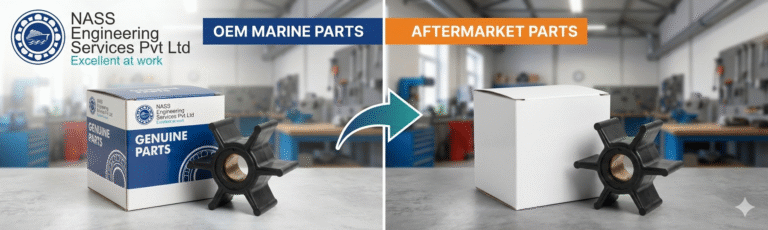
For modern fleet managers and chief engineers, reducing Operating Expenses (OPEX) is a daily mandate. When a major maintenance window approaches, the procurement department faces a critical decision: invest heavily in genuine Original Equipment Manufacturer (OEM) spares, or significantly cut costs by sourcing aftermarket alternatives.
While non-OEM parts can offer immediate financial relief, applying them to critical marine propulsion systems often introduces hidden, long-term liabilities. The debate between OEM and aftermarket marine engine parts is not just about price—it is about balancing mechanical reliability, vessel safety, and legal compliance.
Here is a data-driven look at when aftermarket parts make financial sense, and when compromising on genuine marine spares leads to catastrophic engine failure.
The Financial Appeal of Aftermarket Spares
The marine aftermarket industry is massive, primarily driven by the high cost and occasionally long lead times of OEM components. Third-party manufacturers often reverse-engineer parts for major engine brands like Caterpillar, Cummins, Detroit Diesel, and Rolls-Royce Bergen.
For non-critical applications, high-tier aftermarket parts (often referred to as “OEM-equivalent”) can perform adequately. These are typically used in auxiliary systems where a sudden component failure does not immediately threaten the vessel’s propulsion, steering, or electrical generation.
Where Aftermarket Parts Are Commonly Considered:
- Low-pressure water piping and standard valves.
- Non-critical gaskets, seals, and O-rings (in auxiliary systems).
- Standardized filters and basic hardware.
However, the cost-saving argument collapses when dealing with the high-stress, high-temperature environment of the main engine’s combustion chamber.
The Danger Zone: When Non-OEM Spares Lead to Catastrophic Engine Failure
Marine diesel engines operate under extreme mechanical tolerances. A deviation of just a few micrometers in a machined component can disrupt the entire operational harmony of the engine.
When fleet managers authorize the use of aftermarket parts for critical systems, they risk the following mechanical failures:
- Fuel Injection System Disruption: Aftermarket fuel pump plungers and injector nozzles rarely match the exact metallurgical hardness and atomization angles of OEM parts. Poor atomization leads to incomplete combustion, carbon buildup, and ultimately, severe cylinder liner scuffing.
- Main Bearing Failure: The metallurgical composition of main and big-end bearings is carefully guarded by OEMs. Substandard aftermarket bearings can suffer from rapid delamination under high loads, leading directly to crankshaft scoring and catastrophic engine failure.
- Reduced Time Between Overhauls (TBO): OEM components are engineered to last for a specific, data-backed running hour interval. Aftermarket parts often degrade faster, forcing vessels into premature, unscheduled maintenance and effectively erasing any initial cost savings.
Classification Society Compliance & Insurance Risks
Beyond mechanical reliability, the OEM vs. aftermarket debate carries severe legal and financial implications.
Major maritime insurance policies and Classification Society standards (such as ABS, DNV, and IRS) require vessels to be maintained in a seaworthy condition using approved components. If a vessel loses propulsion in a high-traffic zone (like the Strait of Hormuz) and causes an incident, the subsequent root-cause investigation will scrutinize the engine’s maintenance logs.
If investigators determine that a non-approved aftermarket part caused the failure, the vessel’s insurance claim may be voided entirely due to non-compliance. Sourcing verified, genuine components is just as much about legal protection as it is about mechanical performance.
The NASS Engineering Verdict: Strategic Sourcing for Peak Reliability
At NASS Engineering, our priority is zero unplanned downtime for our clients. While we understand the pressure to optimize procurement budgets, we draw a hard line when it comes to the core mechanics of main propulsion and power generation.
When our certified technicians execute a scheduled marine diesel engine overhaul, we strictly utilize OEM-standard tolerances. We advise fleet managers to prioritize genuine components for all moving parts, fuel delivery systems, and internal cooling mechanisms.
For vessels requiring rapid, reliable procurement, we assist in sourcing verified marine spare parts globally, ensuring that every component installed meets exact manufacturer specifications. Whether you require parts supply or are deploying our riding squads for emergency marine engineering services in UAE ports, prioritizing component integrity is the only proven method for long-term OPEX reduction.
Frequently Asked Questions (FAQ)
Does using aftermarket parts void a marine engine’s warranty?
Yes, in almost all cases, installing non-OEM parts on critical engine systems will instantly void the manufacturer’s warranty for the affected system and potentially the entire engine.
What is an “OEM-equivalent” marine part?
“OEM-equivalent” usually refers to parts manufactured by the exact same factory that produces the parts for the engine brand, but sold without the engine brand’s logo. While these are safer than standard aftermarket parts, traceability and quality control documentation must still be rigorously checked.
How can I verify if a marine spare part is genuine?
Genuine OEM parts come with specific serial numbers, certificates of authenticity, and distinct packaging. Partnering with authorized distributors and certified marine engineering contractors is the safest way to prevent counterfeit parts from entering your supply chain.