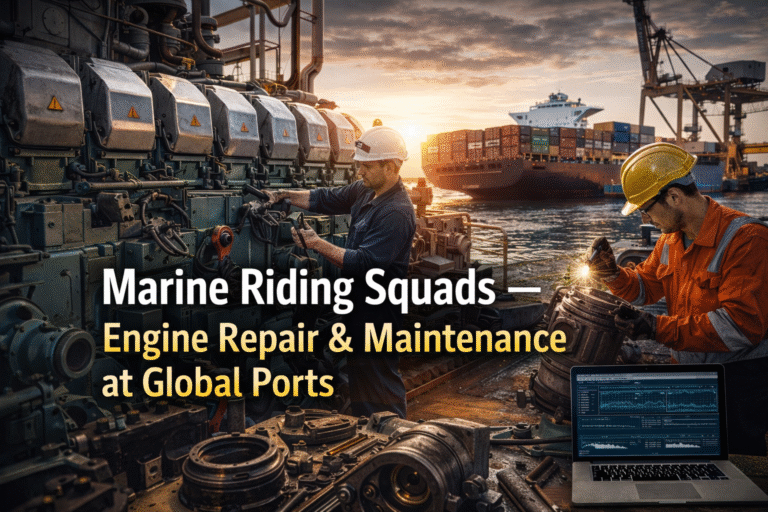
Marine operations rarely fail at convenient times or locations. Engine issues often occur mid-voyage or at unfamiliar ports, where delays translate directly into off-hire costs, missed schedules, and operational risk. This is where marine riding squads play a critical role in maintaining vessel reliability.
Marine riding squads provide on-board engine repair and maintenance support at global ports, allowing corrective and preventive work to be carried out without waiting for dry docking or shipyard availability. When deployed correctly, riding squads reduce downtime, stabilize engine performance, and keep vessels operational across international trade routes.
What Are Marine Riding Squads?
Marine riding squads are specialized engineering teams deployed to vessels while they are in operation or temporarily alongside at port.
Unlike shipyard-based repairs, riding squads:
- Work directly on board the vessel
- Operate within limited port stays
- Focus on critical machinery and systems
- Support vessels across multiple global locations
Their primary objective is to restore or maintain operational reliability without disrupting voyage schedules.
When Are Riding Squads Required?
Riding squads are typically deployed under time-critical or operationally constrained conditions.
Common scenarios include:
- Engine performance degradation during voyage
- Repeated alarms or abnormal readings
- Deferred maintenance due to schedule pressure
- Breakdown risks before dry docking
- Emergency repairs at foreign ports
In many cases, riding squads prevent small issues from escalating into major failures.
Scope of Work Performed by Marine Riding Squads
Engine Repair and Maintenance
The core focus of most riding squads is main and auxiliary engine reliability.
Typical tasks include:
- Troubleshooting engine performance issues
- Cylinder head and fuel system inspection
- Injector replacement and calibration
- Valve maintenance
- Bearing checks and clearance verification
- Minor overhauls within operational limits
Work is prioritized based on risk and available time.
Condition Monitoring and Diagnostics
Riding squads rely heavily on diagnostics to make accurate decisions quickly.
Engineering assessments may include:
- Vibration trend evaluation
- Temperature and pressure analysis
- Load and performance comparison
- Oil condition review
Data-driven diagnostics allow engineers to target the root cause instead of applying temporary fixes.
Support During Voyage or Port Stay
Depending on vessel schedules, riding squads may:
- Join the vessel mid-voyage
- Carry out work during short port calls
- Remain on board across multiple ports
- Coordinate work alongside cargo operations
This flexibility is what makes riding squads valuable for global operations.
Advantages of Marine Riding Squads at Global Ports
Reduced Downtime
By addressing issues immediately, riding squads:
- Prevent unplanned stoppages
- Reduce off-hire periods
- Avoid waiting for dry dock windows
Time saved directly translates into cost savings.
Cost Control
Riding squad interventions often:
- Eliminate emergency shipyard repairs
- Reduce scope during dry docking
- Prevent secondary damage
Planned riding squad work is usually more economical than reactive breakdown repairs.
Global Operational Flexibility
Global riding squad capability ensures:
- Consistent engineering standards worldwide
- Familiarity with international port constraints
- Faster response at remote locations
This is especially important for vessels operating across regions and time zones.
Challenges in Riding Squad Operations
While effective, riding squad operations come with constraints that require experience to manage.
Common challenges include:
- Limited time alongside
- Restricted access to spare parts
- Safety and permit requirements at different ports
- Coordination with ship crew and port authorities
Experienced engineering teams plan interventions carefully to maximize impact within these limits.
Integration with Planned Maintenance and Dry Docking
Riding squads do not replace dry docking or major overhauls. Instead, they complement them.
Effective integration allows:
- Deferred work to be stabilized before dry dock
- Better planning of overhaul scope
- Reduced surprises during inspection
- Improved dry dock efficiency
Riding squad findings often inform long-term maintenance strategies.
Best Practices for Successful Riding Squad Deployment
From an engineering perspective, successful riding squad operations follow clear principles:
- Clear definition of work scope before boarding
- Availability of critical spares and tools
- Use of diagnostics to guide decisions
- Close coordination with vessel crew
- Proper documentation of findings and actions
- Post-intervention performance monitoring
Execution discipline is critical in time-limited environments.
Role of Riding Squads in Modern Marine Operations
As vessels operate under tighter schedules and higher efficiency demands, riding squads have become an essential part of modern marine maintenance strategies.
They enable:
- Continuous operation
- Proactive risk control
- Better lifecycle management of engines
- Global engineering consistency
Riding squads bridge the gap between emergency repair and planned maintenance.
Marine riding squads often operate as part of a broader maintenance and reliability strategy rather than as a standalone solution.
For major corrective work beyond on-board limits, a planned marine engine overhaul ensures long-term performance recovery and controlled downtime.
Advanced diagnostics such as vibration analysis are frequently used by riding squads to identify imbalance, misalignment, and early-stage mechanical faults before they escalate.
Precision tools like laser alignment play a critical role during onboard reinstallation and commissioning, especially after component replacement or corrective repairs.
When riding squad interventions are aligned with the overall dry docking process, vessel operators can significantly reduce unexpected scope and delays during scheduled dockings.
Conclusion
Marine riding squads provide a practical and effective solution for engine repair and maintenance at global ports. By delivering skilled engineering support directly on board, they help vessel operators maintain reliability, control costs, and avoid unnecessary downtime.
When integrated into a broader maintenance strategy, riding squads enhance operational resilience across worldwide marine operations.