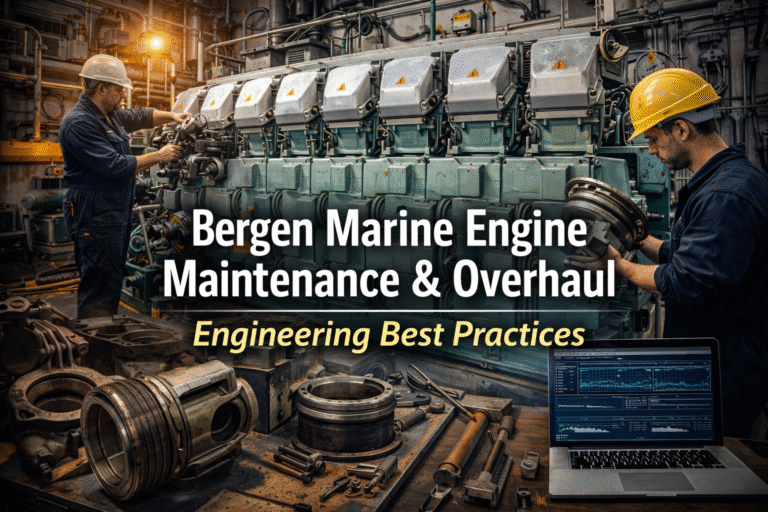
Bergen marine engines are widely used in offshore vessels, ferries, and power-critical marine applications where reliability and load response are non-negotiable. Known for their robust construction and fuel efficiency, these engines still require disciplined maintenance and correctly planned overhauls to deliver long-term performance.
This article explains engineering best practices for Bergen marine engine maintenance and overhaul, focusing on condition-based decision-making, failure prevention, and lifecycle reliability rather than reactive repair.
Understanding Bergen Marine Engine Operating Characteristics
Bergen Engines engines typically operate under demanding conditions such as variable load profiles, continuous running hours, and harsh marine environments.
Key characteristics that influence maintenance planning include:
- Medium-speed operation
- High thermal and mechanical loads
- Long service intervals when properly maintained
- Sensitivity to lubrication quality and cooling efficiency
These characteristics make engineering-led maintenance essential.
Importance of Structured Maintenance Planning
Unstructured or calendar-only maintenance often leads to:
- Early component wear
- Reduced fuel efficiency
- Unexpected shutdowns
- Expensive corrective overhauls
Best practice maintenance is based on:
- Running hours
- Load patterns
- Operating environment
- Condition monitoring data
This approach allows maintenance actions to be planned rather than forced by failure.
Routine Maintenance Best Practices
Lubrication System Management
Lubrication is one of the most critical factors in Bergen engine reliability.
Best practices include:
- Regular oil analysis to detect wear metals and contamination
- Monitoring oil pressure stability
- Ensuring correct oil grade and viscosity
- Timely filter replacement
Ignoring oil health is one of the fastest paths to bearing and liner damage.
Cooling System Maintenance
Cooling inefficiencies directly impact combustion stability and component life.
Engineering focus areas:
- Heat exchanger cleanliness
- Jacket water temperature control
- Seawater system corrosion monitoring
- Early detection of scaling or fouling
Stable cooling ensures consistent engine performance under load.
Fuel System Health
Fuel system issues often manifest as power loss, rough running, or increased exhaust temperatures.
Maintenance should include:
- Injector condition checks
- Fuel pump calibration
- Filtration efficiency monitoring
- Fuel quality management
Precision in fuel delivery directly affects engine efficiency and emissions.
Condition Monitoring and Diagnostics
Modern Bergen engine maintenance relies heavily on diagnostics rather than assumptions.
Key monitoring methods include:
- Vibration trend analysis
- Exhaust temperature profiling
- Cylinder pressure monitoring
- Performance deviation tracking
Condition monitoring helps identify developing faults before they cause secondary damage. Techniques such as vibration analysis play a critical role in identifying imbalance, misalignment, and early-stage mechanical defects.
When Is Overhaul Required?
Overhaul should never be triggered by failure alone.
Engineering indicators for overhaul include:
- Progressive loss of compression
- Increasing oil consumption
- Persistent abnormal vibration
- Repeated alarms under normal load
- Declining thermal efficiency
Planned overhauls reduce downtime and protect critical components. In such cases, a planned marine engine overhaul helps restore performance while minimizing unplanned downtime and secondary damage.
Bergen Marine Engine Overhaul Best Practices
Pre-Overhaul Engineering Assessment
Before any overhaul:
- Review engine performance history
- Analyze oil and vibration data
- Inspect previous repair records
- Define clear overhaul scope
This avoids unnecessary dismantling and cost escalation.
Component-Level Inspection and Repair
During overhaul, attention should be given to:
- Pistons and piston rings
- Cylinder liners
- Bearings and crankshaft journals
- Fuel injection components
- Valves and valve seats
Precision measurement and proper tolerances are critical.
Alignment and Reinstallation
Post-overhaul alignment errors are a common cause of premature failures.
Best practices include:
- Shaft alignment verification
- Foundation integrity checks
- Controlled torque procedures
- Gradual load commissioning
Mechanical precision directly impacts service life. Using precision laser alignment during reinstallation significantly reduces bearing loads and prevents premature mechanical failures.
Post-Overhaul Testing and Validation
An overhaul is incomplete without validation.
Testing should include:
- No-load and load trials
- Temperature and pressure stability checks
- Vibration baseline recording
- Performance benchmarking against historical data
Validation confirms overhaul quality and prevents early-life failures.
Integration with Dry Dock and Major Maintenance Windows
Bergen engine overhauls are often planned during major maintenance windows such as dry docking.
Coordinating engine overhaul with other ship systems allows:
- Better time utilization
- Reduced operational downtime
- Improved cost control
- Safer working conditions
Integrated planning improves overall vessel readiness. Understanding the broader dry docking process allows engine overhauls to be aligned effectively with hull, propulsion, and auxiliary system work.
Long-Term Reliability Strategy
Sustainable Bergen engine performance depends on:
- Consistent maintenance discipline
- Accurate data interpretation
- Planned intervention cycles
- Skilled engineering execution
Reactive maintenance shortens engine life. Planned maintenance extends it.
Conclusion
Bergen marine engine maintenance and overhaul demand an engineering-driven approach that prioritizes data, precision, and planning. When maintenance is structured and overhauls are executed methodically, Bergen engines deliver predictable performance, extended service life, and reduced lifecycle cost.
Reliability is not achieved during repair. It is built through disciplined maintenance and informed overhaul decisions.