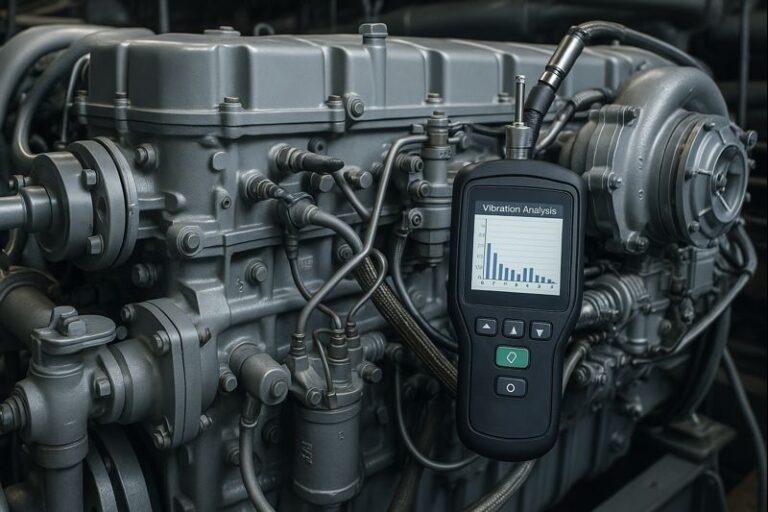
In modern marine engineering, failures rarely happen without warning.
Most mechanical breakdowns begin as small, measurable changes in vibration patterns long before visible damage occurs.
Vibration analysis is one of the most powerful diagnostic tools used today to detect early-stage faults in marine engines, gearboxes, shafts, thrusters, and propulsion systems. When applied correctly, it allows operators to fix problems before they become failures.
At NASS Engineering Services Pvt. Ltd., vibration analysis is a core part of our predictive maintenance approach for marine, offshore, power, and defence vessels.
What Is Vibration Analysis in Marine Engineering?
Vibration analysis is the process of measuring and interpreting mechanical vibrations generated by rotating and reciprocating equipment.
Every machine vibrates.
The pattern, frequency, and amplitude of vibration reveal the condition of internal components.
By analyzing these signals, engineers can identify:
- Imbalance
- Misalignment
- Bearing wear
- Gear defects
- Shaft damage
- Looseness
- Structural resonance
This makes vibration analysis a non-invasive, real-time health check for marine machinery.
Why Vibration Matters in Marine Systems
Marine engines and propulsion systems operate under:
- Continuous load
- Variable speeds
- High torque
- Corrosive environments
- Long running hours
These conditions accelerate wear.
Unchecked vibration leads to:
- Bearing failure
- Shaft fatigue
- Seal damage
- Cracked foundations
- Gear tooth damage
- Increased fuel consumption
Controlling vibration directly improves reliability and efficiency.
Key Marine Equipment That Requires Vibration Monitoring
Vibration analysis is especially critical for:
• Marine Diesel Engines
Detects imbalance, combustion issues, and crankshaft problems.
• Gearboxes
Identifies gear mesh faults, misalignment, and bearing wear.
• Propulsion Shafts
Detects bent shafts, misalignment, and coupling issues.
• Thrusters (Bow & Azimuth)
Identifies bearing wear, seal damage, and gear defects.
• Waterjet Systems
Detects pump imbalance and cavitation-related issues.
• Turbochargers
Identifies rotor imbalance and bearing degradation.
Common Marine Faults Detected Through Vibration Analysis
1. Shaft Misalignment
One of the most common and destructive issues.
Symptoms detected:
- High axial vibration
- Increased bearing temperature
- Seal leakage
Misalignment accelerates bearing and seal failure if left uncorrected.
2. Rotational Imbalance
Occurs due to uneven mass distribution.
Detected by:
- High vibration at running speed (1× RPM)
- Increased stress on bearings and shafts
Balancing corrects this before damage spreads.
3. Bearing Wear and Failure
Bearings fail gradually and predictably.
Vibration analysis detects:
- Early-stage bearing defects
- Lubrication issues
- Surface fatigue
This allows replacement before seizure occurs.
4. Gear Defects
Gear wear is common in propulsion gearboxes and thrusters.
Detected faults include:
- Broken teeth
- Pitting
- Misalignment
- Poor lubrication
Early detection prevents catastrophic gearbox failure.
5. Structural Looseness
Loose mounts and foundations amplify vibration.
Consequences:
- Cracked frames
- Misalignment
- Fatigue failure
Vibration trends expose these issues early.
How Vibration Analysis Works in Practice
A standard vibration monitoring process includes:
1. Data Collection
Sensors measure vibration in:
- Vertical
- Horizontal
- Axial directions
Measurements are taken at defined machine locations.
2. Frequency Analysis
Signals are converted into frequency spectra to identify fault sources based on known mechanical frequencies.
3. Trend Monitoring
Comparing data over time reveals deterioration trends.
This is far more valuable than one-time measurements.
4. Diagnosis & Recommendations
Experienced marine engineers interpret the data and recommend:
- Alignment
- Balancing
- Bearing replacement
- Overhaul scheduling
Why Vibration Analysis Is Better Than Breakdown Maintenance
Breakdown Maintenance
- Reactive
- Expensive
- Causes downtime
- Risks secondary damage
Predictive Maintenance (Vibration-Based)
- Planned
- Cost-effective
- Prevents failures
- Extends equipment life
Industry data shows predictive maintenance can:
- Reduce maintenance costs by up to 30%
- Reduce downtime by over 40%
- Extend equipment life significantly
Vibration Analysis vs Visual Inspection
| Aspect | Visual Inspection | Vibration Analysis |
|---|---|---|
| Internal faults | ❌ Not visible | ✅ Detected early |
| Real-time condition | ❌ Limited | ✅ Continuous |
| Failure prediction | ❌ No | ✅ Yes |
| Accuracy | Low | High |
Vibration analysis detects problems before visual signs appear.
When Should Marine Operators Use Vibration Analysis?
Vibration monitoring is recommended:
- After installation or overhaul
- After dry docking
- During commissioning
- When noise or temperature increases
- At regular operating intervals
- Before long voyages
Consistent monitoring delivers the best results.
How NASS Engineering Uses Vibration Analysis
At NASS Engineering, vibration analysis is integrated with:
- Laser shaft alignment
- Engine diagnostics
- Gearbox inspection
- Thruster and propulsion audits
- Dry dock support
- Condition-based maintenance programs
Our engineers combine field data with marine engineering experience to provide accurate diagnostics and practical solutions.
Real Benefits for Vessel Owners and Operators
Using vibration analysis leads to:
- Fewer breakdowns
- Lower repair costs
- Longer equipment life
- Better fuel efficiency
- Improved safety
- Higher operational availability
For offshore and defence vessels, this reliability is critical.
Conclusion — Vibration Analysis Is a Reliability Tool, Not Just a Test
Vibration analysis is not about finding faults — it is about preventing failures.
When used as part of a predictive maintenance strategy, it transforms how marine systems are maintained.
By understanding vibration behavior, marine operators gain control over maintenance schedules, costs, and vessel availability.
With deep expertise in marine diagnostics and propulsion systems, NASS Engineering Services Pvt. Ltd. delivers vibration analysis solutions that protect assets and extend service life.